
Updated 13 November 2026 · Reviewed by Ahmer Faiz, Founder, Vano Removals
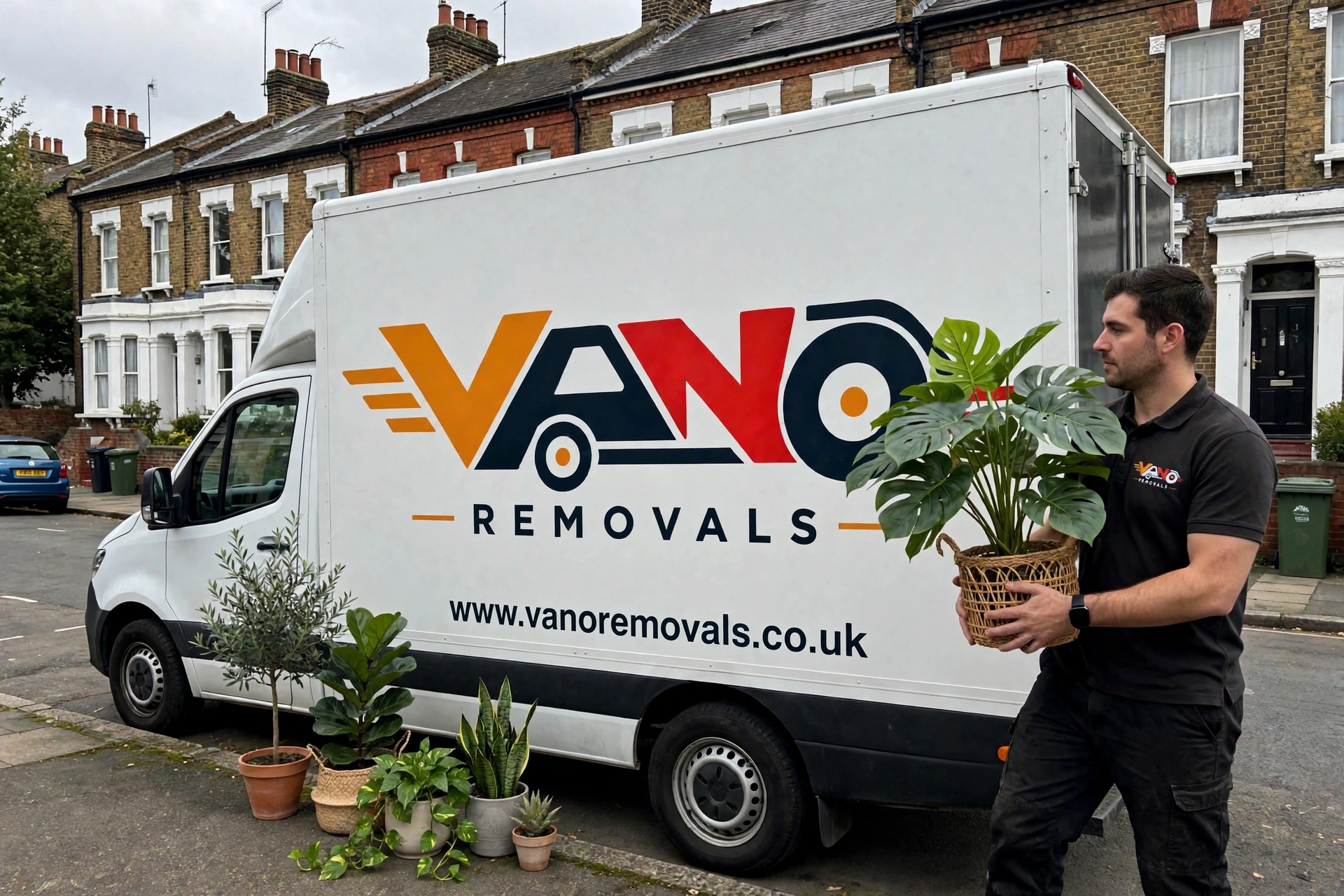
Houseplants are the quiet casualties of moving day. The furniture gets wrapped, the boxes get labelled, the fragile crate gets a warning sticker — and the plants end up wedged wherever there is a gap, arriving at the new flat snapped, spilled or frozen. It does not have to be that way. Plants move well when they are prepared like everything else: a little planning, the right packing, and a clear agreement with your removal company about who handles them.
London adds its own wrinkles. Flats above shops, walk-ups with narrow stairs, lift bookings with strict time slots, and a van parked wherever the bay allows — plants enjoy none of that. Give them the same structured treatment as the rest of the move and they will come through it.
Two weeks before: prune, repot, inspect
Start with a health check. Prune dead or yellowing leaves and trim back anything leggy — a compact plant travels better than a sprawling one, and pruning now gives it time to settle before the move. If a plant is in a heavy ceramic or terracotta pot, move it into a lightweight plastic nursery pot of the same size for the journey. The decorative pot can travel separately, wrapped, in a box. You cut the weight, and you stop worrying about a shattered pot on the stairs.
Check every plant for pests. Look under the leaves and along the stems. You do not want to carry an infestation into a new home, and you certainly do not want it spreading to a neighbour’s plants in a shared hallway or lift. Treat anything you find now, while there is still time for the treatment to work.
This is also the moment to decide which plants are actually coming. A plant that is barely surviving, or one you have been meaning to rehome, may be kinder to give away than to drag across London. Be honest with yourself — moving day is not the time for sentimentality about a half-dead fern.
Watering: timing matters more than amount
The most common plant-moving mistake is watering on the morning of the move. Wet soil is heavy, it sloshes, and it leaks onto everything around it. Water two to three days before moving day instead, so the soil is lightly damp — enough that the plant is comfortable, dry enough that nothing drips.
Cacti and succulents want the opposite treatment: let them dry out fully for a week before the move. They store water in their leaves and stems, and dry soil is lighter and cleaner to handle.
Pack them like the fragile things they are
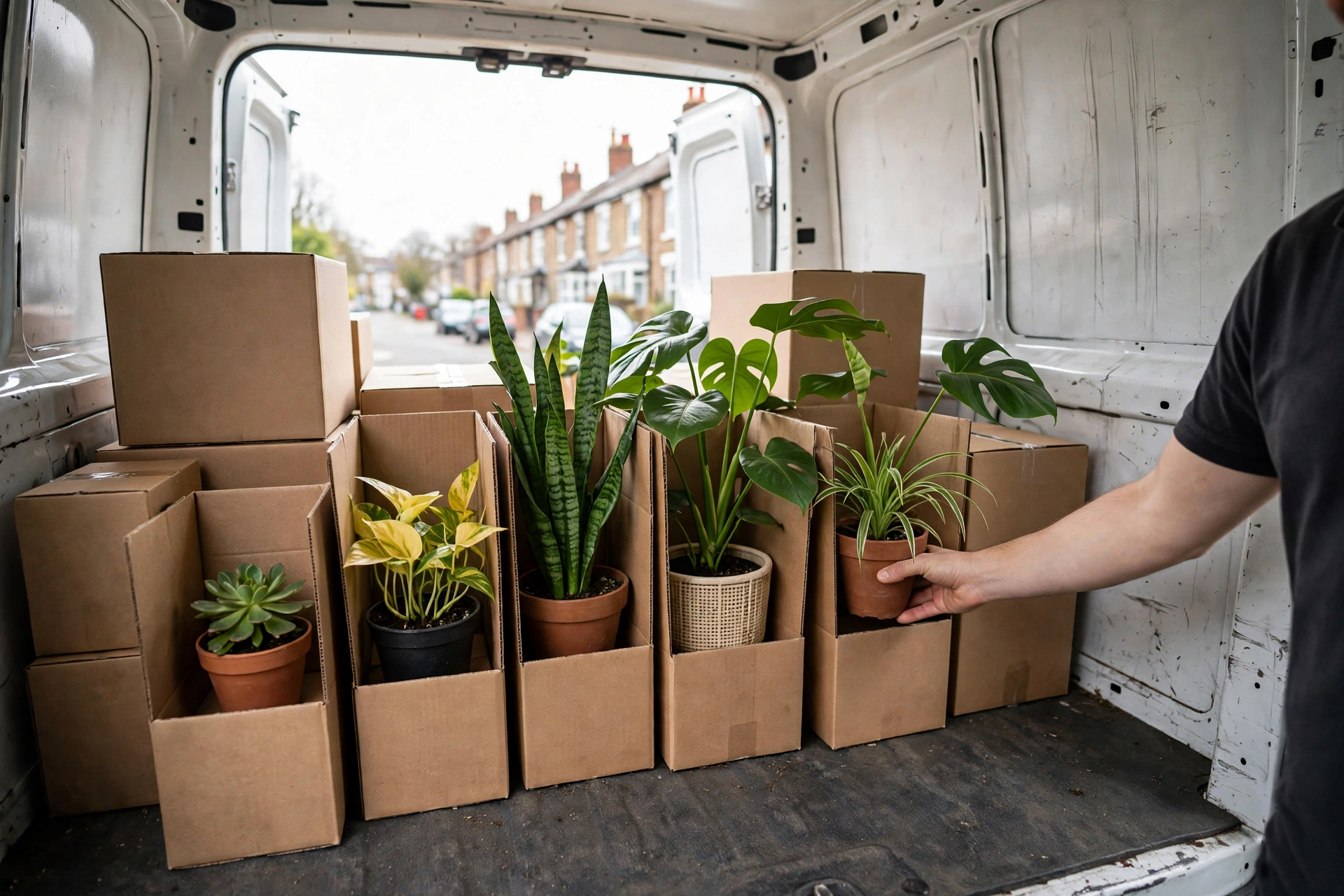
Small and medium plants travel best in open-top boxes with dividers — wine boxes and bottle boxes from the off-licence are ideal, and they cost nothing. One plant per compartment, pots wedged with scrunched packing paper so they cannot tip. Tuck paper loosely around the foliage to stop stems snapping against each other, but do not crush the leaves. If you would rather hand the packing over, our packing service can take the whole job on.
Tall plants need a different approach. Wrap the pot in paper and tape it secure, then wrap the foliage loosely in a cone of kraft paper or hessian, tied gently at the top like a bouquet. For very tall specimens, a wardrobe box with the top left open works well — the plant stands upright, the box protects the pot, and the open top lets the foliage breathe.
Label every box clearly: "LIVE PLANTS — THIS WAY UP — FRAGILE". Movers handle dozens of boxes; a clear label is what stops your monstera ending up sideways under a box of books.
Hanging plants should come down a day or two before the move, not on the morning. Take them out of their macramé hangers, wrap the hangers separately, and box the plants as above.
Tall, trailing and awkward shapes
The plants that break are rarely the small pots; they are the tall, the trailing and the spined. A tall plant travels best with its canes tied gently to one central support and its pot wedged so it cannot slide, never held by its stems. Trailing plants should be coiled up onto the soil surface and pinned lightly rather than left to hang over the box edge, where one knock shears them. Cacti and anything with spines get wrapped in a sleeve of corrugated card, handled by the pot, and kept away from the carrying straps. Awkward shapes are the reason plants go in open boxes and crates rather than bags: the container takes the knocks so the plant does not.
On moving day: last on, first off
Plants should be the last things loaded and the first things unloaded. They do not want hours in a closed van — heat builds fast in summer, and cold snaps bite in winter. If the move involves a gap between addresses, keep the plants with you rather than leaving
 them in the van.
Keep them upright at all times, and never stack anything on top of a plant box, however tempting the flat surface looks. In the new place, put them somewhere safe and out of the way — a bathroom or a corner of one room — while the furniture goes in. They can wait an hour; they cannot survive being knocked over by a sofa.
One London-specific note: if your building needs a lift booking, factor the plants into the time slot. They are quick to carry but awkward — broad leaves, trailing stems, dripping saucers. And if the van is parked around the corner, carry the plants yourself on a final trip rather than leaving them for the last van run. Short journeys on foot are kinder than long waits in a parked van. If the forecast is wet, see our guide to moving in the rain.
Cold, heat and the van: temperature honesty
A removals van is not heated or cooled, and plants feel that faster than furniture does. On a normal moving day with the plants last on and first off, most houseplants shrug off an hour or two in the van at London temperatures. The exceptions are a January move with long waits at both ends, and a heatwave afternoon: on those days the tender plants, the seedlings and anything you would genuinely grieve should travel in your car, where the temperature is the one you are sitting in. It is not a failure of planning to split them; it is the planning.
What to confirm with your removal company
Plants sit in a grey area for many removal companies. Some will move them happily as part of a house move, others exclude them, or exclude liability for them, because plants are living things that can suffer from temperature, delays and handling no one can fully control. Neither position is wrong — but you need to know which one you are dealing with before moving day.
Ask directly, and get the answer in writing as part of your written quote: will the crew move the plants, are there any exclusions, and what happens if a plant is damaged? If plants are excluded, you will move them yourself — useful to know now, not at 8am on moving day. This is the same principle as our guide to what removal companies won’t move: exclusions are always easier to handle when you know them in advance.
Do not assume, do not rely on a verbal "it'll be fine", and do not hide the plants among the boxes hoping no one notices. A clear written agreement protects both sides.
Plants and the gap between addresses
If your move has a gap, a night or a month where belongings sit in storage, the plants are the exception to the plan. Most storage units are dark, unheated and unvisited, which is a slow end for anything green. Plants bridge the gap somewhere with light and a human in it: a friend's windowsill, the new place if you get the keys early, or your car and a hallway for a single night. Arrange it when you arrange the storage, not on the day, because "the plants can go in the unit too" is the one sentence that reliably ends in replacements.
After the move: unpack them first
Once you are in, the plants come out of their boxes before anything else. Unwrap them, stand them upright, and give each one water — the journey is dehydrating even when the soil started damp. Put them in similar light to what they had before: a bright-loving plant does not want a dark hallway, even temporarily.
Resist the urge to repot for at least a couple of weeks. The plant has just been through pruning, a pot change, a van journey and a new home — that is enough change for now. Let it settle, watch for drooping or yellowing, and adjust water and light gradually. Most plants sulk for a week or two after a move and then recover. That is normal, not a sign you did something wrong.
If your move involves storage, one addition: plants do not belong in a storage unit for weeks. They need light and water. If there is a gap between moves, the plants stay with you or with a friend — not in the dark.
Moving houseplants safely is mostly common sense applied early: prepare them weeks out, pack them properly, keep them with you on the day, and confirm the arrangement in writing. Do that, and they will be thriving in the new place while you are still unpacking the kitchen. For the room that usually takes longest, see our guide to packing the kitchen.
If you are planning a London move and want to talk through the practicalities — including anything unusual like a large plant collection — call Vano Removals on 07459 180023 or get a written quote. Tell us what you are moving and we will confirm what is possible in writing before anything is booked.
The first week: light, water and patience
Expect a sulk. A plant that has been pruned, boxed, carried and re-lit will often drop a few leaves or droop for days, and most recover once they have steady light and their normal watering rhythm back. Put each plant in light as close as you can manage to what it had before, resist the urge to feed or repot anything in the first fortnight, and water on the plant's old schedule rather than in apology. Judge the move at the end of the second week, not the second day: by then the ones that are going to perk up have, and the rest have told you something honest about the journey.

Related services and guides


About the author

Ahmer Faiz, Founder, Vano Removals
Ahmer runs the small London crew that carries out every Vano move, sets the published hourly rates on this website, and replies to every Google review personally. Every guide on this site is written from the moves the team actually does, and checked against the council and TfL pages it quotes.
Reviewed by Ahmer Faiz on 5 November 2026 · Next review: 5 May 2027 · More about Vano Removals