Vano Removals
About Us
Contact
Vano Removals crew moving stock and fixtures for a London retail move
Rated 5.0 on Google

Shop & Retail Moves in London

Refits, openings, closures, pop-ups and stock transfers, planned around trading hours and usually worked out of hours. Standard jobs run on a published hourly card from £170; refit-scale work is priced per job in an itemised written quote, every run listed before the first one happens.

No deposit to bookFree cancellation up to 24 hours beforeRated 5.0 on Google
07459 180023

START YOUR ENQUIRY

Tell us about your move

Enter the key details so we can review your moving enquiry.

We'll confirm the details before you book.

By submitting, you agree to our Privacy Policy and Terms.

Retail Moves From £170
Published card, 2-hour minimum
Written Quote First
Refit work itemised per job
Around Trading Hours
Out-of-hours at the same rates
No Deposit to Book
Free cancellation to 24 hours

Quick answer

We move stock, fixtures and fittings for London shops: refits, new openings, closures, pop-ups, market stalls and transfers between branches, usually worked out of hours around trading. Standard jobs are crew time on the published card (Driver Help £70 per hour, 2 Men £85, 3 Men £100, 2-hour minimum), so a pop-up move is £170 and a branch stock transfer usually £255. Refit-scale work is surveyed and priced per job in an itemised written quote. We do not fit out shops: no shopfitting, no electrical or plumbing for displays, no fixed signage. No deposit; free cancellation up to 24 hours before.

Price
Driver Help £70/hr, 2 Men £85/hr, 3 Men £100/hr; standard jobs from £170; refit-scale work itemised per job
Minimum booking
2 hours
Who it is for
Independent shops, boutiques, chains moving branches, market traders and pop-ups across London
Where
London-wide: high streets, shopping centres, markets and retail parks
Terms
No deposit; free cancellation to 24 hours before; quotes valid 7 days
WORKED TOTALS

What Retail Moves Typically Cost

Real totals for the retail jobs people actually book, worked from the published card. Bigger business moves sit with commercial services; stock held between addresses follows the business storage transport model.

Retail jobCrewTypical timeTypical total
Pop-up or market stall: kit and stock in, or out2 Men2 hours (minimum)£170
Stock transfer between two branches, one load2 Men3 hours£255
Small shop closure: stock and fixtures to your storage2 Men4 hours£340
New shop opening: fixtures and opening stock in and placed3 Men4 hours£400
Branch fit-out support run: fixtures delivered and positioned3 Men5 hours£500
One delivery run with the driver loading and placingDriver Help2 hours (minimum)£140
Full refit: strip-out, hold period runs and the return for reopeningSurveyed crewProgrammed over the works windowItemised quote per job

Illustrations, worked from our published hourly card (Driver Help £70, 2 Men £85, 3 Men £100 per hour, 2-hour minimum), checked October 2026. Your written quote confirms the total for your shop before you book. Included beside every price: stock carried in your own order, fixtures protected and dismantled where they come apart, out-of-hours working where the site allows it at the same rates, and disposal items separated for your own waste route. Refit-scale work is never priced off this table: it is surveyed and itemised per job, run by run, so the strip-out, any runs during the hold and the return for reopening each carry their own listed price before you commit.

Retail Moves Are Timed by Trading, Not by Us

A house move happens when the owners are ready. A shop move happens in the gaps retail leaves: after the last trading day, before the fitters arrive, in the loading window the centre grants, on the one morning the high street allows a van at the door. That is why this page is organised by the shape of the job rather than by shop type. A boutique refit and a convenience store closure have more in common with each other, as moves, than either has with a shop of its own kind trading normally.

Six shapes cover almost every retail booking we run. Find yours, and the quote starts from the right questions: your dates, your stock order, and the rules of the building the shop sits in.

The Refit: Out, Held, Back In

Quoted per job, itemised run by run

The biggest retail job and the one this page is built around. Stock and fixtures come out after the last trading day, travel to your own storage or warehouse while the fitters work, and come back in reopening order when they hand the shop over. Every run is listed in the quote before the first one happens.

A New Shop Opening

Usually 3 Men, about 4 hours, £400

Fixtures, rails, shelving and the opening stock delivered from your warehouse, your supplier or your old unit, and placed where the plan puts them. The shopfitters built the shell; we fill it, in the order your merchandising team wants to dress it.

A Shop Closure

Usually 2 Men, about 4 hours, £340

Everything out by the lease date: stock to the branches staying open, fixtures to your warehouse or storage, and the unit left empty for handover. Disposal items are separated for your own waste route, never mixed into the loads.

Pop-Ups and Market Stalls

Usually 2 Men, 2 hours, £170

A short let, a market pitch, a seasonal stand: stock, rails, a counter and the stall kit in on setup day and out again at the end of the run, often early or late around the venue’s own access rules.

Branch to Branch Stock Transfers

Usually 2 Men, about 3 hours, £255

Seasonal stock rebalanced, fixtures following a refit, a closing branch’s stock split across the ones staying open. Stock travels in your branch order and comes off at the receiving end in the order its team asked for.

A Centre Unit Move

Priced from the slot the centre gives you

In a shopping centre the move runs on the centre’s clock: booked loading bay, goods lift slot, service corridor route, permit in hand. We plan the crew and the load order around the slot you book, because the slot, not the carrying, decides the day.


A London shop floor with stock and fixtures ready for a retail move
An evening move on the high street: stock boxes going onto the tail lift outside a closed shop

Centres, High Streets and the Rules That Run the Day

The carrying on a retail move is the easy part to price. The part that decides whether the day works is access, and access in retail belongs to the building, not to us. In a shopping centre, deliveries and removals run through a managed route: a service yard or loading bay booked in advance, a goods lift booked in slots, a service corridor between the bay and your unit, and a permit or delivery note from centre management, sometimes with the vehicle registration and crew names given ahead. Some centres only allow moves outside trading hours at all. As the tenant, you hold the lease, so the bookings sit with you: book the bay, the lift and the permit window, pass us the paperwork, and we plan the crew size and the load order around the slot we are given.

On a high street the rules are the council’s and the clock’s. Loading bays have signed windows, many streets are pedestrianised or restricted in the middle of the day, and the workable move is often the first hours of the morning or the evening after close. Where a suspension or dispensation is needed to park a van at the door, the figures and notice periods are your borough’s, and they are worth checking when the quote is agreed rather than on the day. Road charges follow the same pattern: the Congestion Charge is £18 per day from 2 January 2026, charged 07:00 to 18:00 Monday to Friday and 12:00 to 18:00 at weekends, and an out-of-hours move often falls outside those hours entirely. Any road charges that apply to your job are confirmed in your written quote before you book.

Tell us the site rules when you enquire: the centre’s delivery guide if there is one, the slot times, the route from bay to unit. A missed slot costs a centre move more time than any staircase ever has, and it is the one part of the day no crew can carry its way out of.

Clothing rails in garment covers being wheeled out of a boutique during a shop move

Stock and Fixtures, Handled the Retail Way

Stock is not furniture. It has an order, a season and a shop floor waiting for it, and it is handled the way your own team organised it.

Rails stay hanging

Hanging stock travels on its rails wherever the route allows, rolled or carried as rails, so it comes off the van and goes back on display without a morning of re-hanging from boxes. Where a rail genuinely has to come down for a tight route, garments are wrapped in rail order and the order is kept, not shuffled.

Boxed stock keeps your order

Your department, season or branch sequence is the loading plan. Boxes are labelled to it, loads are built so the first stock needed at the other end comes off first, and nothing is re-sorted in transit. Counting stays with your team: stocktaking and barcode records are yours, and the move does not pretend to replace them.

Fixtures, glass and the fragile list

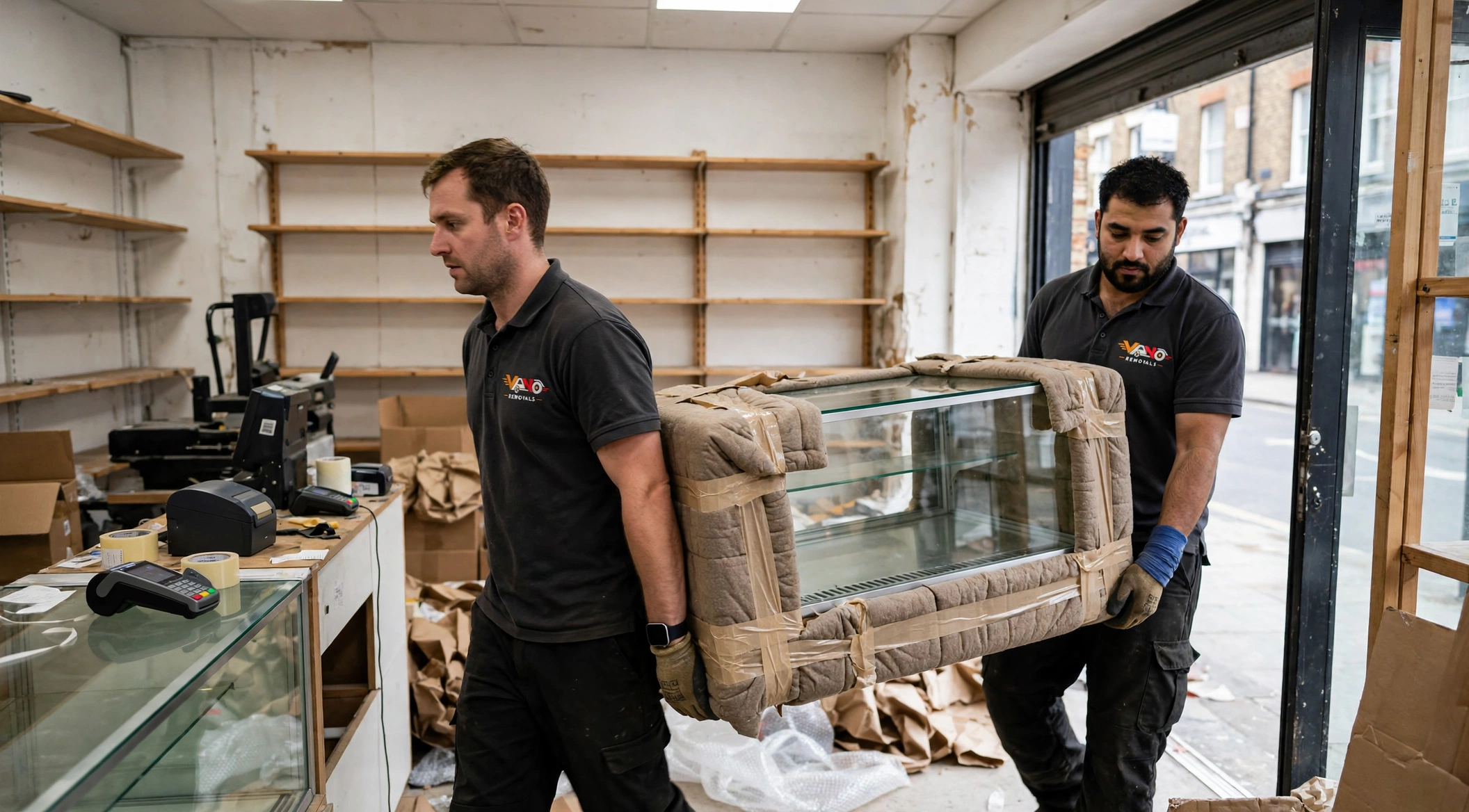
Gondolas and shelving are dismantled where they come apart and rebuilt as free-standing pieces. Counters are wrapped and carried as the heavy pieces they are. Mannequins come apart at their joints and travel padded, never by a limb. Glass display cases and tops are blanket-wrapped, kept upright and strapped, and loaded where nothing can slide into them.

Shop fixtures and shelving being moved during a London retail relocation
A glass display counter, blanket-wrapped at the edges, being carried out of a shop

We Move Shops. We Do Not Fit Them Out.

The boundary matters most on a refit, where a removals crew and a fit-out crew work the same shop in the same fortnight. Here is the line, stated before you book rather than discovered during it.

No shopfitting

We move stock, fixtures and fittings. We do not fit out shops: no stud work, no built-in counters or joinery fixed into the building, no fit-out snagging. Your shopfitter builds the shell; we empty the old one and fill the new one.

No electrical or plumbing for displays

Display lighting that needs wiring, a plumbed coffee point, a wired till position: those connections belong to your electrician and plumber. We place the units they connect, before or after their visit, in the order your programme sets.

No fixed signage installation

Fascia signs and anything that needs fixings into the building are a sign contractor’s job, with their own access equipment and guarantees. Free-standing signs, A-boards, window graphics on boards and internal display pieces travel and are positioned with the rest of the fit.

Your stock, your cover

Your stock is your business’s insured goods, and it stays that way: nothing on this page promises cover from us. Our insurance position is stated in the written quote in the same words on every job, and high-value stock is worth a word with your own insurer before a move, whichever firm carries it.

On a refit the sequence is what makes the boundary painless. We clear the shop after your last trading day, so your fitters start on an empty unit. During their works, anything you need from storage comes out on booked runs, not favours. When the fitters hand the shop back, we return the stock and fixtures and position them against your merchandising plan, ready for your team to dress. Three trades, three jobs, and the quote you hold from us covers only ours, itemised, so there is never an argument about whose work a line refers to.

While the Shop Is Rebuilt, Storage Is a Transport Job

A refit leaves stock and fixtures homeless for days or weeks, and the honest description of our part in that is short: we do not run a storage facility, for shops any more than for homes. Your stock goes into a unit you rent in your business’s name, or into your own warehouse or another branch. We clear the shop, stack the unit in retrieval order (reopening stock at the front, fixtures behind it), and run loads back out as the reopening needs them.

Two contracts, two bills: the unit and its rent are yours with the operator, on their terms and their access hours; the transport is ours, priced as crew time or inside the refit job’s itemised quote. Access stays with you throughout, which is why a part-load retrieval during the works is a short booked run and never a favour to arrange. The same model runs our business storage work for stock that lives between addresses longer term.

Retail stock loaded for transport to a shop's own storage during a refit
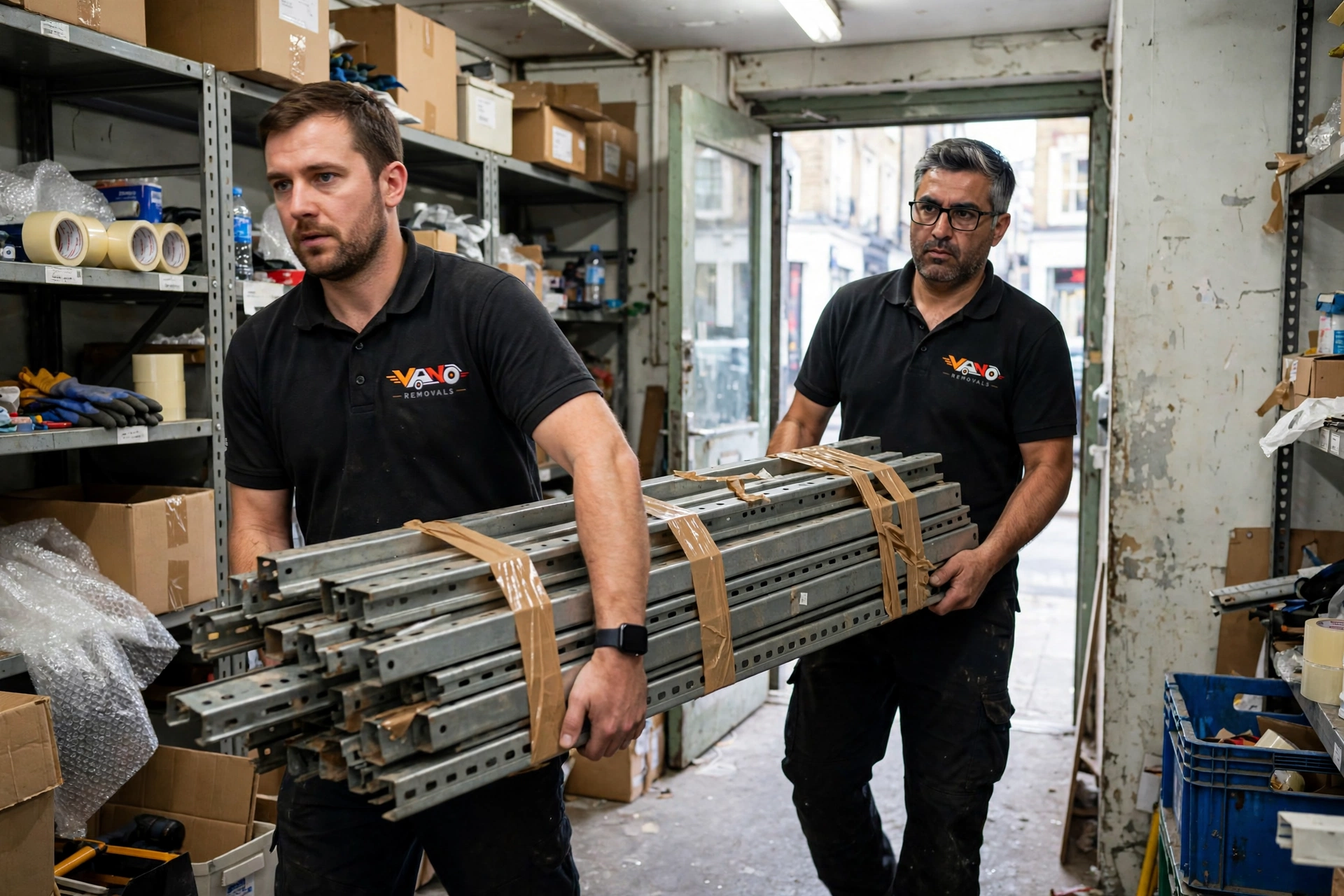
Dismantled shop shelving, bundled and taped, being carried out of the stockroom

What Is Included, and What Is Not

Included in every booking

  • The crew’s time on the published card, or the itemised written quote for refit-scale work, confirmed before you book
  • Stock carried in your own order: rails kept hanging, boxed stock kept in your department or branch sequence, loads built in unloading order
  • Fixtures and fittings dismantled, protected and carried, then reassembled or positioned as free-standing pieces at the other end
  • Blankets, wrap and straps for counters, glass and fragile display pieces as standard
  • Out-of-hours and overnight working where the landlord, centre or street allows it, at the same published rates
  • Coordination with your programme: last trading day, fitters’ window and reopening date planned backwards from the fixed points
  • Disposal items separated on the day and stacked where your own waste route collects them

Not included, stated plainly

  • Shopfitting: no fitting out, no stud work, no built-in joinery. That is your shopfitter’s trade
  • Electrical or plumbing work for displays: wired lighting, plumbed units and powered signage are your tradespeople’s work
  • Signage installation that needs fixings we are not set up to make; free-standing signs and graphics we carry and position gladly
  • Storage: we do not run a facility. During a refit your stock sits in your own unit or warehouse and we run the transport
  • Disposal of old fixtures and fit-out waste: we are not a licensed waste carrier, so it leaves through your arrangements or a carrier you appoint
  • Stocktaking, barcode scanning and inventory counts: your stock records stay with your team
  • Refrigerated or hazardous stock: it needs a specialist carrier, and we will say so before you book if it comes up
Fixtures and display pieces protected with blankets and wrap during a London move
Move-in day at the new shop: rails and stock boxes being brought in through the frontage

How a Retail Move Works

Four steps, built backwards from the dates your shop cannot move: the last trading day and the reopening.

01

Walk the shop with us, on paper

Both postcodes, the stock and fixture list, and photographs of the shop floor. Photographs price a retail move more honestly than measurements alone: rails, gondolas, counters and glass all show up in a picture.

02

Written quote around your dates

The quote comes back in writing, valid for 7 days: crew time on the card for standard jobs, itemised run by run for refit-scale work. It is built around your fixed points: last trading day, the fitters’ window, reopening.

03

The move, in your order

Stock loaded in your sequence, fixtures protected and dismantled where they come apart, the route worked as the site allows: centre slot, service corridor, or the high street window. Out-of-hours where the job needs it.

04

Placed, checked, paid

Stock and fixtures positioned at the other end in the order your team asked for, disposal items left separated for your waste route, and the walkthrough done with you or your manager. Payment is at the time of service.

COMPARE

The Typical Way vs With Vano Removals

Point of comparisonThe typical wayWith Vano Removals
The priceA day rate quoted over the phone, with the refit’s second and third runs surfacing as extras once the programme is under wayA published hourly card for standard jobs, and refit-scale work surveyed and itemised per job, run by run, in writing before the first run
Trading hoursA crew that works office hours and treats an evening load-out as an exception to argue aboutOut-of-hours and overnight working planned from the start where the site allows it, at the same published rates, with no invented surcharge
The stock orderStock boxed by whoever is free, in the order it came off the shelf, and re-sorted at the other end by your teamRails kept hanging, boxed stock kept in your department or branch sequence, loads built in the unloading order your team set
The boundaryA mover who will have a go at the fit-out too, and a blurred argument later about whose work failedThe line stated on this page: we move stock, fixtures and fittings; shopfitting, wiring, plumbing and fixed signage belong to your trades
Storage in a refitYour stock held in the mover’s own facility, on their terms, with retrieval arranged around their diaryYour stock in your own unit or warehouse, access in your hands throughout; we run the transport in and out as booked runs
Deposit and cancellationA deposit taken to hold a date in a busy refit seasonNo deposit to book; free cancellation up to 24 hours before; payment at the time of service

Based on the published prices, terms and service descriptions of London commercial movers and man-and-van operators, checked October 2026. The full four-way comparison of every way of moving is on our compare page.

Content updated October 2026. Prices from our published hourly card, checked October 2026. Congestion Charge figures and charging hours from TfL, checked October 2026. Shopping centre delivery rules, loading windows and permit arrangements are each centre’s and landlord’s own, confirmed for your unit when the quote is agreed. Waste carrier status can be checked on the Environment Agency public register.

Price Your Shop Move

Send both postcodes, the stock and fixture list, photographs of the shop floor, the access at each end, and your dates: last trading day, the works window, reopening. The quote comes back in writing with every run priced. No deposit, and free cancellation up to 24 hours before the move.

Or email info@vanoremovals.co.uk

Rated 5.0 on Google

“Best house removal company around. The team at Vano Removals was punctual, hard-working, and handled our furniture with great care. If you need reliable, stress-free local movers or packing services, I highly recommend them.”
Muhammad Saad
“Vano Removals moved our 2-bed flat from Croydon to Sutton last week…”
Irfan Shahzad

Shop & Retail Move FAQs

Common questions about shop and retail moves, cost first. If you do not see yours, call us. We are happy to help.

Talk to the team

Published rates, a written quote, and no deposit. The fastest way to price a retail move is to send both postcodes, the fixture list and photographs of the shop floor.

07459 180023

Standard retail jobs are priced as crew time on our published card: Driver Help £70 per hour, 2 Men £85 per hour, 3 Men £100 per hour, with a 2-hour minimum on every booking. A pop-up or market stall move is £170 at the 2 Men minimum; a stock transfer between branches is usually £255 over about 3 hours; a small shop closure, stock and fixtures out to your storage or warehouse, is usually £340 over about 4 hours. Refit-scale work (a full strip-out, a hold period and a return for reopening, or several shops on one programme) is surveyed and priced as an itemised written quote per job, so every run and every crew hour is listed before you commit. Your written quote confirms the total before you book, and there is no deposit.

Yes, where the landlord, the centre management or the street allows it, and most retail moves are planned that way: shopping centres restrict loading to booked windows, and high streets are often only workable early or late. Out-of-hours timing is agreed when the job is quoted, around your trading hours and the site rules. The price does not change for the clock: there is no night or weekend surcharge on the card, and larger out-of-hours programmes are priced in the same itemised written quote as everything else.

No. We move stock, fixtures and fittings; we do not fit out shops. There is no shopfitting in a booking with us, no electrical or plumbing work for displays, and no signage installation that needs fixings we are not set up to make. Gondolas, counters, shelving and rails are dismantled, carried and reassembled or positioned as free-standing pieces. Anything that has to be built into the building (stud work, wired display lighting, plumbed units, fixed signage) belongs to your shopfitter, and we plan our runs around theirs: out before their works start, back in when they hand the shop over.

Stock travels the way your shop already organises it. Hanging stock stays on its rails, rolled or carried as rails where the route allows, so it goes back on display without re-hanging from boxes. Boxed stock stays in your own order: your department, season or branch sequence is kept, boxes are labelled to your plan, and loads are built so the first stock you need at the other end comes off first. What we do not do is count it: stocktaking, barcode scanning and inventory checks stay with your team, who know the stock. We carry the plan you set; we do not replace it.

Most centres run deliveries and removals through a managed route: a service corridor or service yard, a goods lift booked in slots, a loading bay booked in advance, and a permit or delivery note from centre management, sometimes with named vehicle and crew details. Those bookings sit with you as the tenant: you hold the lease, so you book the bay and the lift and pass us the slot times and any permit paperwork. We then plan the crew and the load order around the slot, arrive in the window given, and work the route the centre sets. Tell us the centre rules when you enquire, because a missed slot, not the carrying, is what usually costs a centre move its time.

Into storage you hold: your own unit at a self storage operator, your warehouse, or another branch. We are the transport in the middle, not the storage. We clear the shop, load stock and fixtures in the order you will want them back, deliver them into your unit or warehouse stacked for retrieval, and run them back for reopening when the fitters hand over. The unit contract, its rent and its access stay between you and the operator; our runs in and out are priced as crew time or inside the refit job’s written quote. Two contracts, two bills, and nothing of yours sits in a facility of ours, because we do not run one.

Not in our vans. Standard removals transport is not refrigerated, and chilled or frozen food, pharmaceuticals and anything else that needs a controlled temperature belongs in a specialist refrigerated vehicle with its own temperature records. The same goes for hazardous stock (fuel, solvents, aerosols in trade quantities): it travels under the carrier rules for those goods, not in a removals load. Tell us what the stock is when you enquire and, if it is outside what we carry, we will say so plainly before you book rather than discover it on the day.

Disposal is arranged by you, not sold by us. We are a removals firm, not a licensed waste carrier, so old fixtures, broken display units and fit-out waste leave through your own trade waste arrangements or a registered waste carrier you appoint: centres often require their own waste route, and the duty of care paperwork stays in your name, as the law expects. What we do on the day is separate what is leaving from what is travelling, stack the disposal items where your carrier or the centre’s waste service can collect them, and keep them out of the loads. Packaging from new fixtures is left neat with you for your recycling, the same as any job we run.

Yes, and it is one of the most regular retail jobs we run: seasonal stock rebalanced between branches, fixtures following a refit from one shop to another, a closing branch’s stock split across the branches staying open. Each run is quoted on the card from the postcodes and the load, stock travels in your branch order, and the receiving branch gets the load in the order its team asked for. Regular runs between the same branches are quoted run by run; there is no contract to sign and no account facility to set up.

Insurance is as stated in your written quote: ask us to confirm in writing.

The carrying is rarely the constraint; the permissions are. Centre loading bays, goods lift slots and landlord approvals can need days to book, and a refit move has to land between your last trading day and your fitters’ start. Two to three weeks is a comfortable runway for a full shop move; a stock transfer or a pop-up move can often be turned around in days. Send the dates you are working to (last trade, fitters in, reopening) when you enquire, and the plan is built backwards from the fixed points.

Ask for a quote with both postcodes, the stock and fixture list (photographs of the shop floor help more than measurements alone), the access at each end, and your dates: last trading day, the works window, and reopening. The quote comes back in writing and is valid for 7 days; refit-scale work is itemised run by run. There is no deposit to book. Changing your date is free up to 24 hours before the move; inside 24 hours, a cancellation charge of up to 25 percent of the quoted price applies. Payment is at the time of service.

Customer Reviews

What our customers say

Real, unedited reviews from customers we’ve moved across London.

5.0Excellent
Google reviews

“Best house removal company around. The team at Vano Removals was punctual, hard-working, and handled our furniture with great care. If you need reliable, stress-free local movers or packing services, I highly recommend them.”

Muhammad Saad

Google review · October 2026

Review 1 of 7: Muhammad Saad
Read all reviews on Google

These are unedited reviews from our Google Business Profile. Moved with us recently? Your honest review helps other Londoners choose with confidence.