Updated 14 November 2026 · Reviewed by Ahmer Faiz, Founder, Vano Removals
Ask anyone who has moved house which room they dread packing and the kitchen wins every time. It is the room with the most items, the most fragile items, and the most awkward shapes — and it is the room you still need to use on the morning of the move. The good news is that kitchens follow a logic: pack in the wrong order and it fights you; pack in the right order and it is mostly methodical work.
Start with what you do not use
Begin a week or more before moving day, with the things that live at the back of cupboards. The fondue set, the spare baking trays, the glasses that only come out at Christmas, the appliance you bought during lockdown and used twice. These can be boxed early without touching your daily routine, and getting them out of the way shrinks the job that is left. For the rest of the house, see our room-by-room packing guide.
This is also the moment to be honest about what is not coming. Chipped mugs, a pan with a loose handle, three half-empty spice jars from 2022 — moving them costs the same effort as moving things you love. Declutter as you go and the kitchen you unpack at the other end is the one you actually want.
Food: run it down, do not pack it up
In the final week, plan meals around what is already in the cupboards and freezer. Tins and jars are heavy, and a box of food is a box that cannot be dropped, tilted or left in a warm van. Frozen food will not survive moving day unless the journey is very short — eat it, give it away, or accept it is going. The night before the move, pack one small cool bag with the next morning’s essentials and treat everything else as already moved.
Liquids and cleaning products
The kitchen is where the leaks live. Anything liquid that is travelling at all, cooking oils, sauces you refuse to run down, cleaning sprays, should be checked for a lid that actually seals, stood upright in one dedicated box lined with a bag, and kept away from food and from anything paper. Half-used chemicals under the sink are usually better replaced than moved: they are the classic source of the box that arrives smelling of bleach with its bottom softening. If a bottle would ruin the load by leaking, it does not travel; that one rule prevents nearly every liquid disaster.
The wrapping system that works
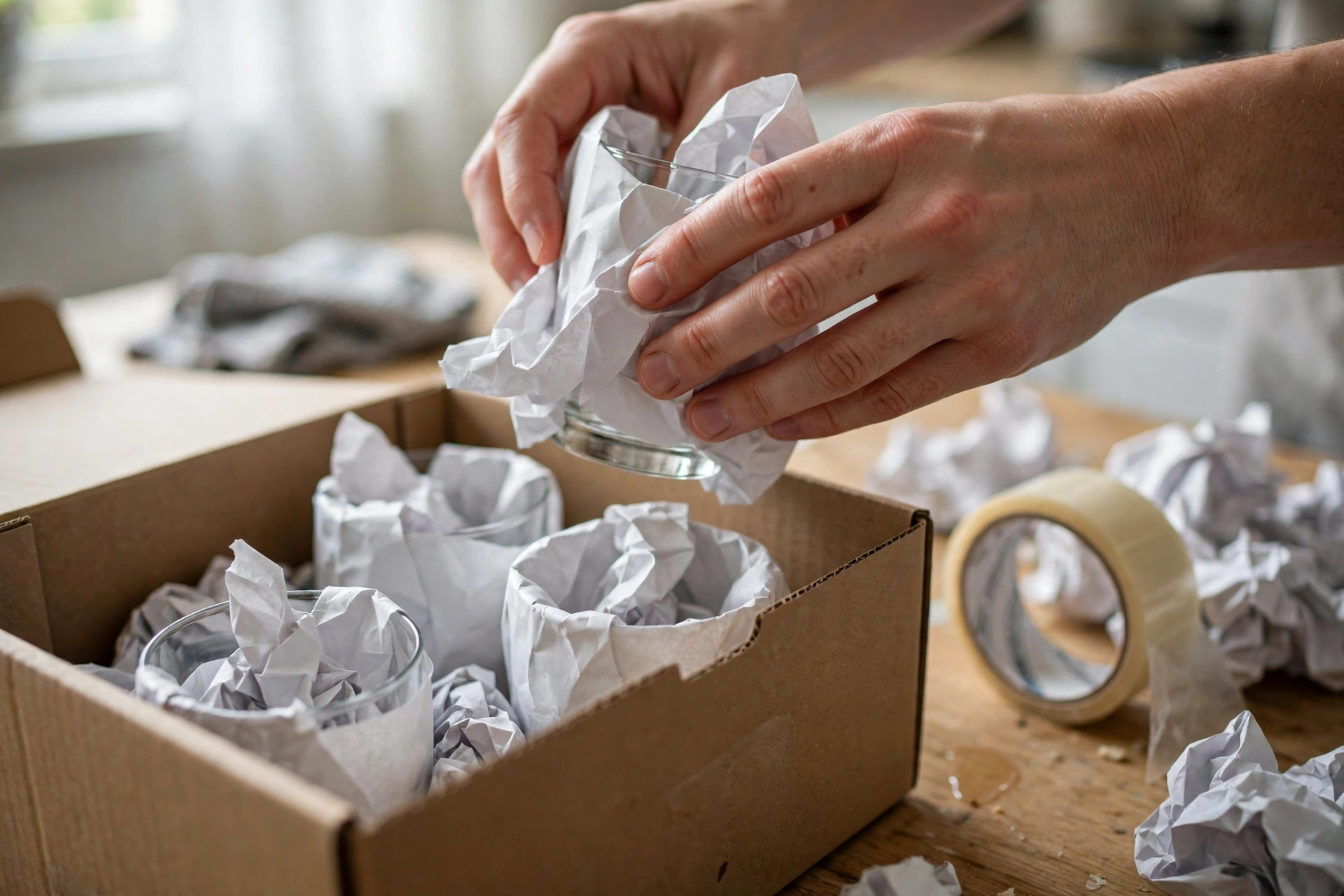
Fragile items fail in transit for two reasons: they touch each other, or they can move inside the box. The fix for both is paper and snugness. Wrap each plate individually and stand plates on their edge, like records — a plate lying flat carries the weight of everything above it on its weakest axis, while a plate on edge is remarkably strong. Glasses get paper inside the bowl as well as around the outside, and travel upright, never on their sides.
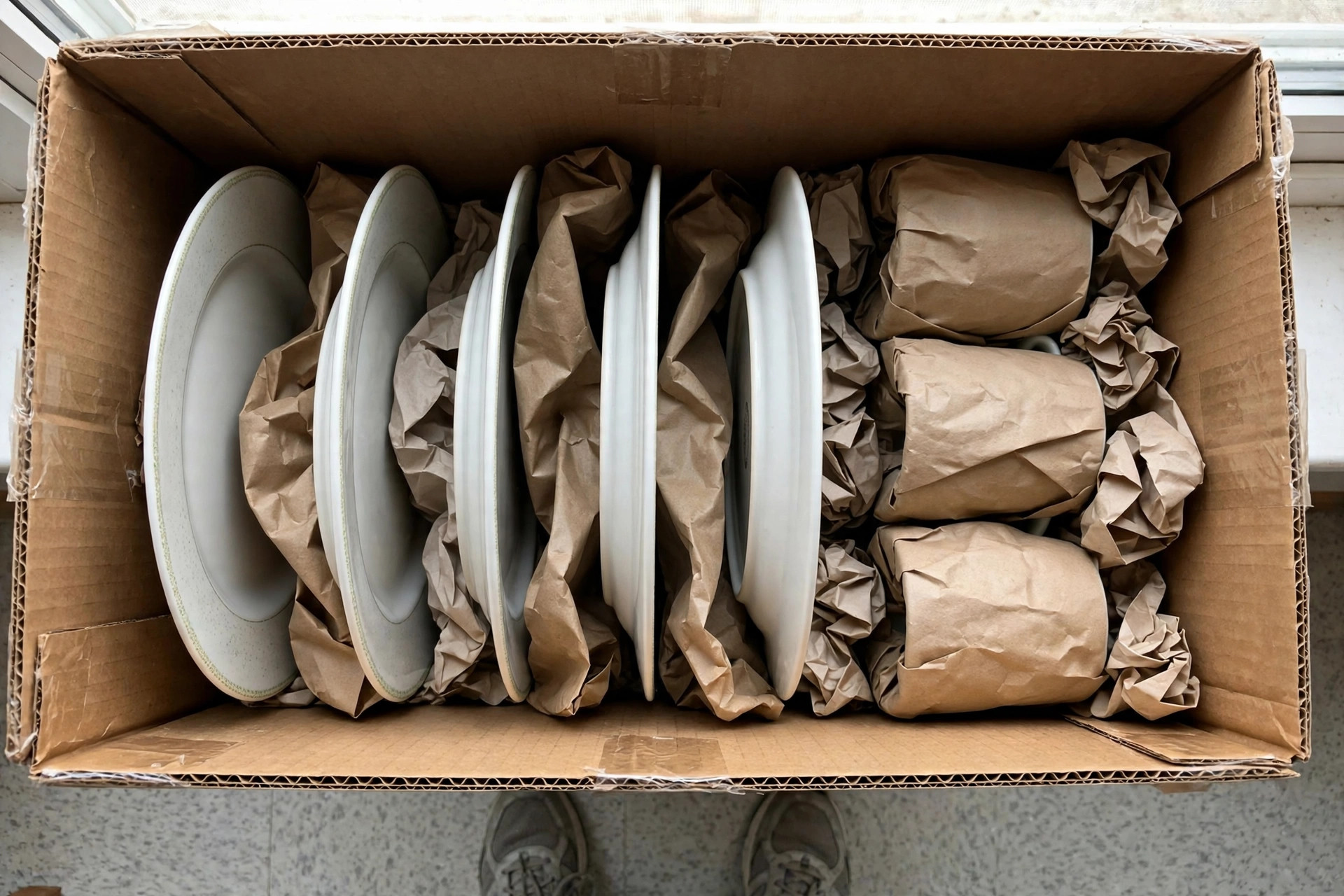
Fill every gap. A box that rattles is a box that breaks things. Scrunched packing paper, tea towels and hand towels all work as void fill — and packing your linens around your fragiles means two jobs done in one box. Keep each box to a weight you can lift comfortably; a smaller box of books-and-tins weight is a classic kitchen injury waiting to happen, so heavy items go in small boxes, light bulky items in the big ones.
Tape the bottom of every box in both directions before you start filling it. Cardboard that gives way on the stairs is how a full set of crockery becomes a partial set.
Appliances and awkward shapes
Small appliances travel best in their original boxes if you still have them. If not, wrap the appliance, coil its cable and tape the cable to the body so it cannot flap or tangle, and pack any loose parts — blender jugs, coffee machine drip trays — in the same box, wrapped separately. Drain anything that holds water the day before: kettles, coffee machines, steam mops. A leaking appliance box quietly ruins whatever is underneath it. For screens specifically, see our guide to packing a TV.
Knives deserve their own moment. Wrap blades individually in cardboard or thick paper and tape them, then pack them flat in a clearly marked box. Never leave loose blades in a mixed kitchen box — the person unpacking at the other end may be tired, distracted, or you.
Knives and sharps, packed safely
The knife block or the cutlery drawer needs ten deliberate minutes. Each blade gets its edge covered, a sheath, a wrap of thick card taped along the blade, or the roll it lives in, before it goes near a box; loose blades in a drawer box are how people cut themselves unpacking at the other end. Pack knives together in one small box or roll, label it as sharps on the outside, and tell whoever unpacks that it exists. Peelers, graters and skewers ride in the same arrangement. It is the least glamorous ten minutes of the kitchen pack and the one most likely to be remembered gratefully.
Labelling that actually helps
“Kitchen — fragile” is a start, but the label that earns its keep at the new house is more specific: “Kitchen — mugs and glasses”, “Kitchen — pans”, “Kitchen — open first”. Boxes are unloaded faster than they are unpacked, and the difference between a calm first evening and a miserable one is usually finding the kettle box without opening six others. Mark the box on two sides and the top — you cannot control which way it faces in the van or the hallway.
One box gets special status: the first-night kitchen box. Kettle, mugs, tea and coffee, a saucepan, a frying pan, plates and cutlery for the household, washing-up liquid, a sponge, bin bags and a tea towel. It loads last and comes first — the same principle as the first-night box in our guide to what to pack in your first-night box when moving house in London. Everything else in the kitchen can wait until tomorrow; this box cannot.
The final 24 hours
The day before the move, the kitchen shrinks to the essentials: the first-night box contents, one pan, and whatever the freezer plan left behind. Everything else is packed, labelled and stacked somewhere that is not in the crew’s path. On the morning itself, the last items go in once they have been used and washed — build that ten minutes into your plan rather than discovering it as the van is being loaded.
If children or pets are part of the move, move their food and bowls into the first-night box plan too. A hungry household makes every delay feel twice as long.
The first-evening kitchen box
One kitchen box should be packed to be opened first and labelled that way. It holds the kettle, two mugs, tea or coffee, a saucepan, a frying pan, a wooden spoon, washing-up liquid and a cloth, bin bags, and the basic cleaning spray for the new kitchen's surfaces. Everything else in the kitchen can wait for the weekend; that box cannot, because the first evening in a new home runs on tea and one hot meal. Pack it last, load it where it can be reached first, and put it on the worktop the moment you arrive rather than in the stack.
If you would rather not pack it yourself
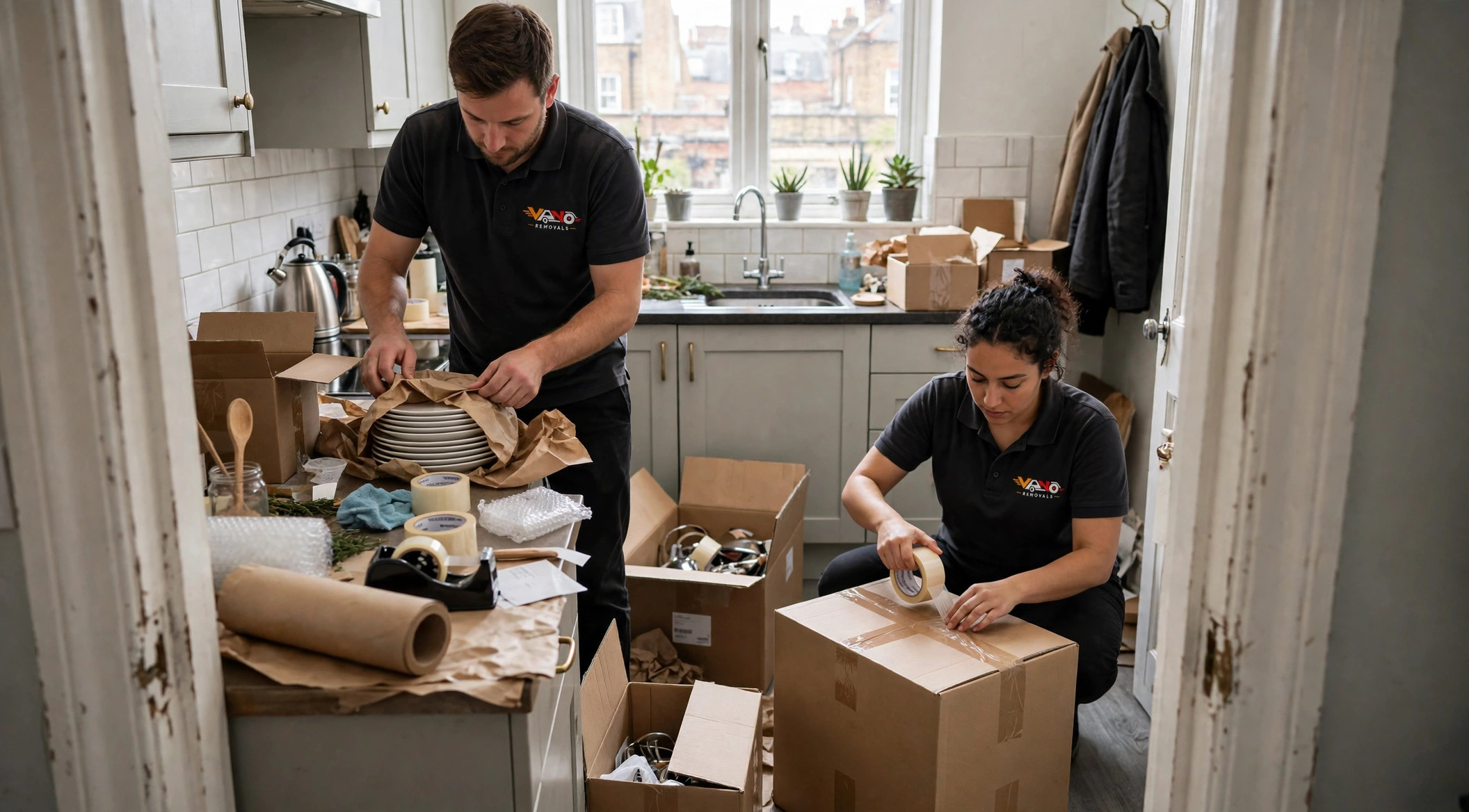
Packing a kitchen properly takes most people the better part of a day, and it is the room where rushed packing shows up as breakages. Plenty of movers book packing help for the kitchen alone and pack the rest themselves. If that is your plan, confirm it in your written quote before the day — packing is a booked extra, not something to agree at the door while the clock is running. Our packing service page explains how we approach it, or simply tell us when you request your quote.
Done in the right order, the kitchen stops being the dreaded room. Start early with what you do not use, wrap for contact and movement, label for the unpacking you will actually do — and protect that one first-night box like it is the most important thing you own. On the first evening in the new place, it is.
Planning a London move? Call Vano Removals on 07459 180023 or get a written quote — and tell us if you want the kitchen packed for you, so it is confirmed in writing before moving day.
Related services and guides
About the author

Ahmer Faiz, Founder, Vano Removals
Ahmer runs the small London crew that carries out every Vano move, sets the published hourly rates on this website, and replies to every Google review personally. Every guide on this site is written from the moves the team actually does, and checked against the council and TfL pages it quotes.
Reviewed by Ahmer Faiz on 5 November 2026 · Next review: 5 May 2027 · More about Vano Removals