Updated 14 November 2026 · Reviewed by Ahmer Faiz, Founder, Vano Removals
Every removal crew knows the moment. The van is loaded in the right order, the day is running to time, and then the sofa reaches the doorway of the new flat and stops, two centimetres too wide in every direction, with a hallway behind it and a queue of furniture behind that. Almost every one of those moments was decided days earlier, at the point where nobody measured anything. The good news is that the measuring takes about ten minutes a room, needs nothing more than a tape measure and a phone, and settles the questions that otherwise get settled the hard way: what travels whole, what comes apart, what leaves by another route, and what needs a different plan altogether.
This guide gives you the measurements that matter, in the order a crew thinks about them: doors first, then sofas, then the tall pieces, then the stairs and lifts they all have to pass through. It ends with the honest part, what happens when something genuinely will not fit, and what we and any other firm can and cannot do about it.
The five measurements that decide the day
For every large piece of furniture there are five numbers worth writing down. The first three belong to the piece itself: its width, its height and its depth, taken at the widest points, which usually means arm to arm on a sofa, cornice to cornice on a wardrobe, and the diagonal of a mattress rather than its flat side. The fourth is the tightest opening on the route, door, hallway turn or stairwell, whichever is smallest. The fifth is the height available at that tight point, because more pieces fail on height while being pivoted than fail on width going straight.
Write the numbers down room by room, and mark any piece whose smallest dimension is within a couple of centimetres of the opening it has to pass. Those are the pieces to raise when you ask for a quote. Our furniture removals work starts from exactly that list: a named problem piece with figures attached is a solvable problem, while a surprise on the day is a delay measured in your hours.
Doors first: the numbers that matter
Measure the opening, not the door. The figure that counts is the clear width between the frame and the opened door at its widest, plus the clear height from floor to the top of the frame. A standard modern internal door in the UK gives you an opening of about 762mm wide and 1981mm high. Older houses are less generous: Victorian and Edwardian stock often has 686mm doors, low lintels and a porch or lobby that narrows the route before the front door is even reached. Front doors themselves are commonly 838mm or wider, which is why the tightest point on the route is so often an internal door, a hallway turn or the door at the top of the stairs rather than the entrance everyone looks at.
Two details catch people out. The first is the door itself: a door that opens against a wall or a radiator rarely reaches a full ninety degrees, and the slab and its handle then sit inside the opening you measured. The second is the turn immediately inside or outside the door. A piece can be narrower than the opening and still fail, because it has to arrive at the opening at an angle the hallway allows. Measure the corridor width as well, and the distance from the doorway to the wall facing it. That last figure decides whether a long piece can be swung square at all.
Sofas: the diagonal test
A sofa has four measurements, and the one most people skip is the one that decides everything. Take the width (arm to arm), the depth (back to front), and the height (floor to the top of the back, with the feet on). Then take the diagonal depth: hook the tape at the top rear corner of the back frame and run it down to the bottom front edge of the arm. That diagonal is the measurement that has to pass through the door when the sofa is pivoted on its end, which is how sofas actually travel through houses.
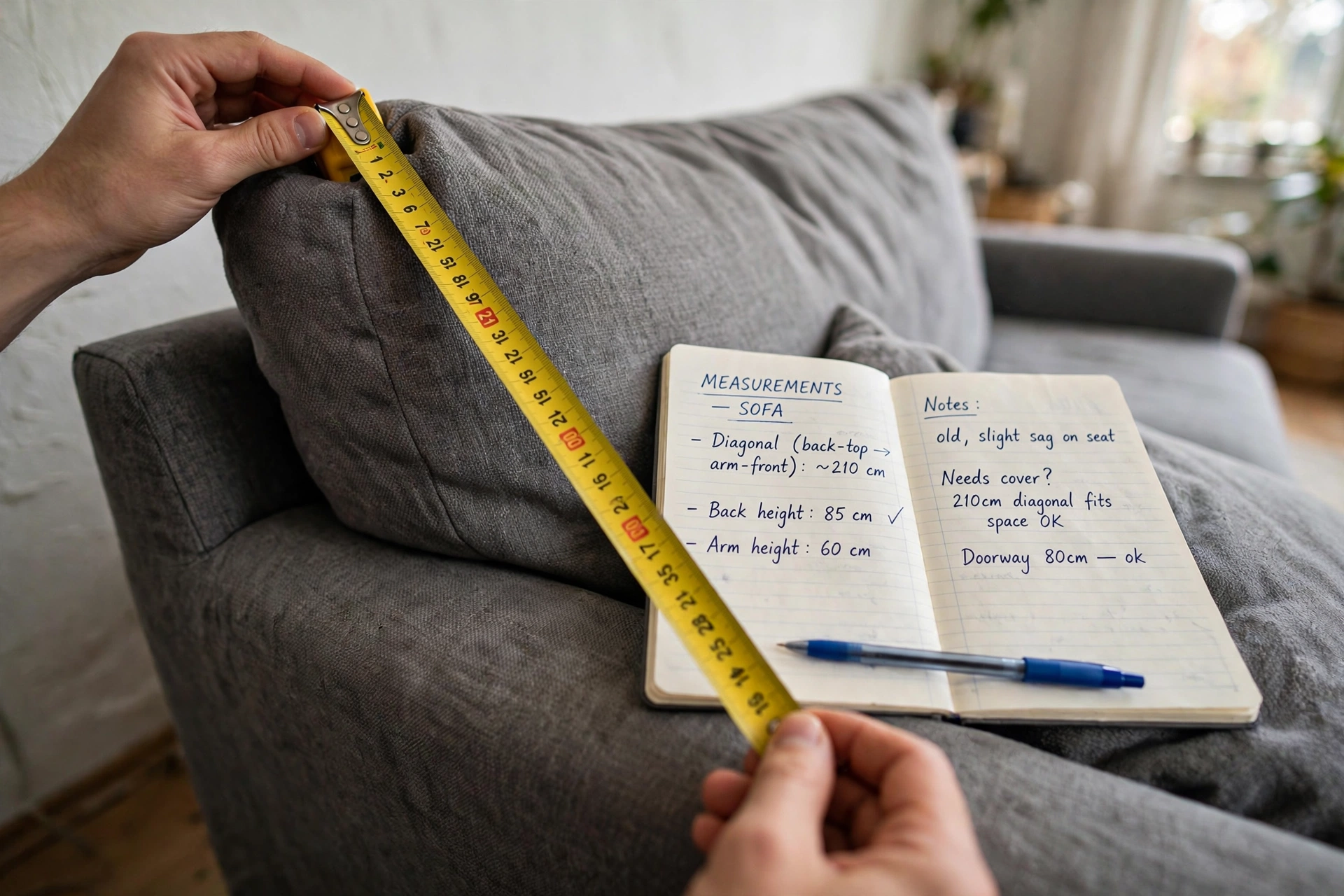
The test is simple. If the sofa's diagonal depth is less than the height of your doorway, the sofa can usually be rotated through it. If the sofa's back height is less than the doorway's width, it can often be tipped onto its end and walked through that way instead. Removable feet are worth real centimetres here: most sofa feet unscrew by hand and taking them off can drop the height by 5 to 10cm, which is frequently the whole argument. Arms are the stubborn part. Some models have bolt-on arms that come off with an Allen key; most do not, and forcing the question on the day risks the frame. If your figures say the sofa fails both tests with the feet off, say so at quote stage. There are honest options, set out below, and all of them are better arranged in advance.
Wardrobes, bookcases and tall pieces
Tall furniture fails differently: not at the door, but at the ceiling. A wardrobe that stands 210cm in a room with 240cm ceilings has only 30cm of pivot room, and on a stairwell turn, where the ceiling follows the slope of the stairs above, the available height can drop sharply at exactly the point where the piece needs to stand up. Measure the wardrobe's height and its diagonal (bottom front corner to top rear corner), then measure the ceiling height at the tightest point of the stairs, not in the middle of the room.
Construction decides the rest. Flat-pack wardrobes and bookcases were designed to come apart and usually do, though a unit that has been assembled, moved and reassembled before may not forgive a third round; check for wobbling joints and stripped fixings before you count on it. Solid antique wardrobes often separate into sections by design (cornice, body and plinth) in a way their owners have forgotten, so look for the joins before assuming the worst. A piece that cannot be dismantled, will not pivot, and will not fit is a quote-stage conversation, and it is a short one if the figures are on the table.
Beds, tables and the pieces that come apart
Most beds are built to dismantle and are the least of your worries, with two exceptions: divan bases, which often come in one or two solid sections that behave like small sofas through doorways, and assembled bed frames whose headboards are taller than the door is wide. Measure a divan section exactly as you would a sofa, diagonal included. Dining tables usually surrender their legs with four bolts, and the top then travels flat; a pedestal table that does not dismantle should be measured like a wardrobe. American-style fridge freezers deserve a mention in any measuring round: widths of 90cm and more are common, against that 762mm standard door, and the doors of the fridge itself sometimes have to come off, which is a job for the manufacturer's instructions rather than improvisation. Ten minutes with the tape now is what keeps these pieces off the problem list.
Stairwells and the turn at the top
Stairs are where measuring earns its money. Three figures matter: the width of the staircase at its narrowest (usually at the handrail, not the wall), the ceiling height above the turn or half-landing, and the headroom on the straight run, where the ceiling of the floor above cuts across. A long piece carried up a straight flight meets that sloping ceiling line halfway, and pieces fail there that sailed through every door in the house.
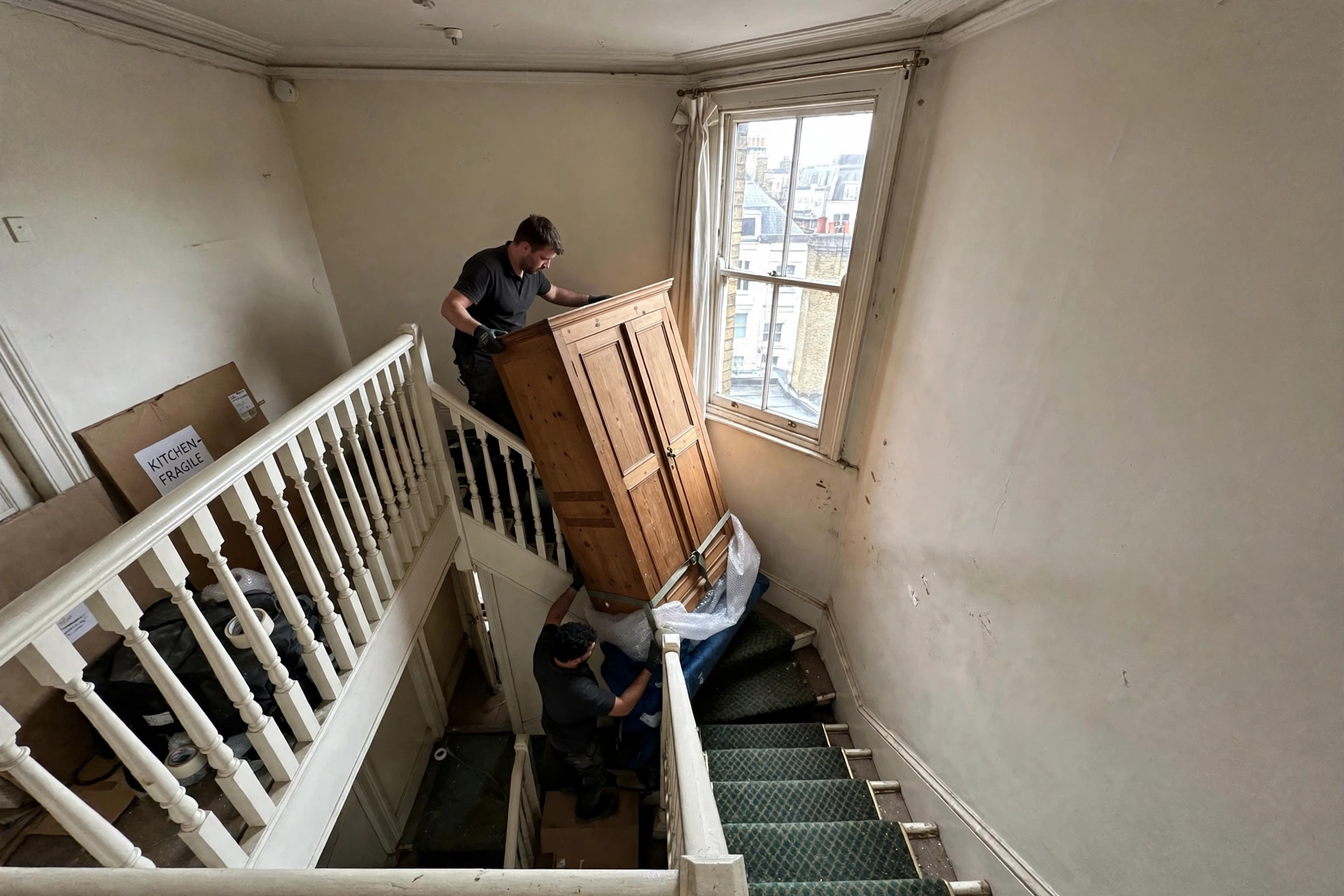
Conversions in converted terraces add their own signature: the turn at the top, where the stairs meet a small landing and a door, often with the ceiling dropping at the same point. The practical test for a tall or long piece is whether it can make the turn while staying below that dropped ceiling, and the practical answer is found with the piece's diagonal and the landing's dimensions in front of you, not with the piece already on the stairs. Where a piece travels matters as much as whether it fits, so walk the route once with the tape before the day and note the banisters, radiators and light fittings that narrow it. It is the same walk that tells you where floors, doors and walls will need protection; our guide to protecting floors, doors and walls on moving day covers that side of it.
Lifts, corridors and mansion blocks
A lift changes the arithmetic rather than removing it. Measure the lift door's clear opening and the car's internal depth and height, and check the diagonal of the car: a long piece that fits the depth flat may still fail if it cannot be angled in through the door. Many mansion block lifts are passenger lifts in the honest sense, sized for people and a pram, and the building's rules may forbid furniture in them altogether or reserve them by booking. Corridors matter in the same way: the turn from corridor to flat door is the mansion block equivalent of the stair turn, and it defeats the same pieces.
The quote-stage questions for any block are therefore simple. What are the lift's dimensions, is it bookable for moves, what are the permitted moving hours, and where does the van stand? A crew chosen to fit the building's window beats a larger crew standing in a corridor waiting for a lift that is not theirs to use.
The route out: gardens, side returns and second doors
When the front route fails, walk the others before concluding anything. Patio and French doors at the back are often the widest opening in the house, and a route through the garden, a side return or a garage turns an impossible piece into a routine carry. Ground-floor windows occasionally serve for a slim piece with the window opened fully, though the opening is smaller than it looks once the frame is counted. Check the route as a route: gate widths, the turn from garden to door, and the ground underfoot, because a long carry over wet grass with a wardrobe is a different job from the same carry down a hallway.
At the destination the same walk applies in reverse, and it is the destination people forget to measure. The old house's access is known from living there; the new one's is a set of assumptions. If you cannot get in before the day, ask the agent or the seller for the two or three figures that matter (door widths, stair turns, lift size) and put them in the quote request. A crew that arrives knowing the new place's tight point plans the load order around it, putting that piece where it can be reached first rather than buried behind everything else.
What happens when a piece genuinely will not fit
Sometimes the figures close every door, and it is better to hear the list of options calmly than to watch a crew discover them. In order of preference, they run like this. First, dismantle: more pieces come apart than their owners realise, and dismantling and reassembly are part of our work when they are booked as part of the job, so a wardrobe or bed that travels in sections is a plan, not a defeat. Second, take a door off its hinges: it gains the thickness of the door itself, a few centimetres, and that is sometimes the whole difference; it is ten minutes with a screwdriver and the hinges go back the same day. Third, change the route, as above. Fourth, change the plan for the piece: it goes to a different address, to a family member, or it is sold or donated before the move rather than after a failed attempt on the day.
What we will not do is force a piece. A sofa wedged hard through a doorway can crack its frame, tear its fabric and take the paint and plaster with it, and the repair bills land on the owner of both the sofa and the house. If a problem piece appears in your quote request with its figures, our written reply will say plainly which of the options above we plan to use, and if none of them works we will tell you that too, before the day rather than during it.
Windows, balconies and the honest limits
Two suggestions always surface for the impossible piece, and both deserve a straight answer. Taking a window out to pass furniture through is real work done by real firms, but the window itself is a glazier's job: a sealed unit or a sash has to be removed and refitted properly, it costs accordingly, and it is arranged in advance with the glazier, not improvised by a removals crew on the morning. Hoisting furniture over a balcony or through an upper window is likewise specialist lifting work with its own equipment and its own firms. It is not part of what we sell, and any quote that waves it in casually should be read with care.
The honest position is simpler than the sales version: nearly every piece that looks impossible is solved by dismantling, a hinge, or another route, and the small remainder are solved by deciding early. A piece measured three weeks ahead has options. The same piece measured on the morning has an audience.
What it costs when furniture is the job
Furniture moves run on our published hourly card: Driver Help at £70 an hour, a 2 Men team at £85 an hour, and a 3 Men team at £100 an hour, with a two-hour minimum booking and £5 per floor where the carry is by stairs. The measuring in this guide is what decides which crew your move needs, so here is the arithmetic worked openly, as rate times hours:
- A single large item (one sofa or wardrobe, collected and delivered locally), Driver Help for 2 hours: £70 × 2 hours = £140
- A one-bed flat where the wardrobe and bed are booked to be dismantled and rebuilt, 2 Men for 3 hours: £85 × 3 hours = £255
- A two-bed flat with several problem pieces and a stair turn at both ends, 2 Men for 4 hours: £85 × 4 hours = £340
- A house move where tall furniture and stairs dominate the day, 3 Men for 5 hours: £100 × 5 hours = £500
The rate includes loading, unloading and carrying, and dismantling and reassembly where they are booked as part of the job. If the day runs long, the extra time is charged at the same hourly rate you booked at. Packing is not included unless it is booked; where it is booked it is done by the same crew at the same rate, with materials charged at cost (boxes £5 each, protective wrap £15, tape £10 a roll). The figures above are illustrations from the card: the written quote for your addresses, with your problem pieces named, is the figure the day is planned around.
How the written quote works
Send the room-by-room list with the measurements of the two or three biggest pieces and the tightest door or stair figure at each address, and the reply is a written quote that settles the crew size, the expected hours and the plan for anything that looks tight. The quote is valid for 7 days. There is no deposit to book, cancellation is free up to 24 hours before the move (inside 24 hours, up to 25% of the quoted price), and payment is taken at the time of service. None of that changes because a piece is awkward; awkward is information, and information at quote stage is what turns a difficult move into a planned one.
A ten-minute measuring checklist
Work through each big piece in the order it will travel. Its width, height and depth at the widest points. Its diagonal, if it is a sofa, divan or tall piece. The feet off, if they come off, and the new height written down. Then the route: the clear width and height of every door on the way, the hallway turn and the wall facing it, the stairs at their narrowest with the ceiling height over the turn, and the lift or corridor figures if there is a block involved. Photograph the tightest point while you are there. End with the destination's route, measured or requested, and put the worst figure in the quote request where it cannot be missed.
Questions people ask about furniture and tight access
Can a crew refuse to move a piece that will not fit? A crew can decline to force one, and should. The workable options are dismantling, a different route, or a different plan for the piece, and all three belong in the written quote rather than in an argument on the stairs.
My sofa went in when I bought it. Why would it not come out? Because it probably came in through a different route, or before the hallway was decorated, the radiator fitted or the door rehung, or it arrived flat-packed in its current room and was assembled there. Houses change around furniture quietly, and the measuring is what catches it.
Do you charge extra for dismantling? No separate charge: dismantling and reassembly are included when they are booked as part of the job, and the time they take sits inside the quoted hours.
Is insurance included?
Insurance is as stated in your written quote: ask us to confirm in writing.
If you have a piece you are worried about, send its measurements with both postcodes and we will reply with a written quote that names the plan for it. Get a written quote here.
Related services and guides

About the author

Ahmer Faiz, Founder, Vano Removals
Ahmer runs the small London crew that carries out every Vano move, sets the published hourly rates on this website, and replies to every Google review personally. Every guide on this site is written from the moves the team actually does, and checked against the council and TfL pages it quotes.
Reviewed by Ahmer Faiz on 5 November 2026 · Next review: 5 May 2027 · More about Vano Removals