

Updated 20 November 2026 · Reviewed by Ahmer Faiz, Founder, Vano Removals
Merton is a borough of two very different kinds of move, and the mistake is treating them as one. In Wimbledon Village and the streets around the Common, the day turns on a parking bay outside a period house, a narrow road, and a council suspension applied for ten full working days ahead. In Mitcham, Morden and Colliers Wood, the day turns on longer carries, wider roads and the same suspension, applied just as early. The price of the move itself is the same published hourly card wherever you are in the borough. What changes is the parking, the access and the timing, and this guide works through all three with real figures, so you can book with the cost already known.
1. What a Merton move costs
The hourly card is fixed and published, and it is the same card on every page of this site. Driver Help is £70 per hour, 2 Men with a van is £85 per hour, and 3 Men with a van is £100 per hour. Winter offer, £5 off every hourly rate. There is a two-hour minimum on every booking, and where the carry is by stairs there is a £5 charge per floor. Lift-served floors carry no floor charge. The totals below are crew time only, before any stair charge, so add £5 per floor if your stairs are part of the carry.
Worked openly as rate times hours, a Merton move looks like this. A studio flat with Driver Help for two hours comes to £140. A one-bedroom flat with 2 Men for three hours comes to £255. A two-bedroom home with 2 Men for four hours comes to £340, and the usual range for a two-bedroom home is £340 to £510, which is 2 Men for four to six hours. A three-bedroom house usually falls between £500 and £700, which is 3 Men for five to seven hours. A single item, a sofa or a wardrobe on its own, starts from £140. These are the ranges to plan around, and the written quote you receive before the day is the figure that counts, valid for seven days from the day it is given.
For the borough as a whole, including Wimbledon, Mitcham and Morden, the starting point is the Merton hub: Removals in Merton. For the service itself, the house removals page sets out what a full house move covers: House Removals.
2. What the hourly rate includes
The hourly rate covers the crew, the van and the work of the move itself. Loading, unloading and carrying are included, and so is dismantling and reassembly of furniture when it has been booked, which matters in Merton more than in most boroughs. The period houses of Wimbledon Village and the older terraces of Mitcham were not built for king-size beds and three-seater sofas, and a bed that comes apart in ten minutes at the start of the day saves an hour of wrestling at the top of a staircase.
What the rate does not include is packing, unless you book it. Packing is charged at the same crew rate, with materials at cost: boxes £5 each, wrap £15, and tape £10 a roll. That separation is deliberate. Some customers want the crew to pack everything, and some want to pack themselves and keep the crew for the heavy work only. Either way the figure is agreed in writing before the day, not discovered on it.
Overruns are charged at the booked hourly rate, so a move that runs an hour long costs one more hour at the same rate, not a new rate. Payment is at the time of service, and nothing is collected before unloading. There is no deposit to pay when you book, cancellation is free up to 24 hours before the move, and cancelling inside 24 hours may be charged at up to 25% of the quoted price.
Insurance is as stated in your written quote: ask us to confirm in writing.
3. The council's parking charges, £36.75 a bay, ten working days' notice
This is the section that saves Merton customers real money, and it is the one most guides get wrong by leaving it out. Merton Council charges £36.75 per bay per day for a parking suspension, plus an administration fee of £36.75 per application, which is non-refundable. So one bay for one day costs £73.50 in total, bay plus admin, paid to the council directly and never part of the removals quote.
Two bays for one day cost £110.25, which is the £36.75 admin fee plus two bays at £36.75 each. A Luton van needs about two bays, because one bay is approximately five to six metres long, so £110.25 is the figure most Merton moves should plan around, not £73.50. Each further day for two bays costs £80.00, which is two bays at £40.00 each, because the daily charge rises to £40.00 per bay from day two, with no further admin fee.
The notice period is ten full working days, and the council publishes no shorter route, so this is not a detail to leave until the week of the move. Ten full working days means two full working weeks in practice, and a bank holiday in the middle stretches it further. You apply online to the council, and card payment is part of the application. Once the suspension is approved, the council emails a waiver notice, which you must print and display in the windscreen of any vehicle parked in the suspended bay.
Two warnings belong here, because they are the two ways a suspended bay fails on the day. First, if your plans change after the paperwork has been generated, an amendment costs £36.75, so check the dates and the number of bays before you submit, not after. Second, the council aims to put warning signs up seven days before the suspension starts, and suspensions for domestic removals are marked by warning signs and cones, but a sign does not keep the bay empty by itself. If another vehicle is parked in your suspended bay on the morning of the move, it is your responsibility to report it to the council on the day. The council cannot investigate or enforce suspensions retrospectively once the period has passed, and it does not operate a towing service, so the crew works around it where they can and the day runs longer.
4. Yellow lines and the streets that catch people out
Not every Merton street needs a bay suspension, and some need a different permission altogether. Where the van has to stand on a single yellow line, the council offers a yellow-line waiver at £36.75 per vehicle per day. You apply at least ten full working days ahead, the same notice as a bay suspension, and you will need the registration, dimensions and fuel type of every vehicle the waiver covers, so have those ready before you start the application rather than on the day you need it.
The streets that catch people out are the narrow ones: the period streets of Wimbledon Village and the roads around the Common, where a van that fits the road does not fit the road with cars parked on both sides, and the streets where a bay that looks empty at 8am fills by 9am. If the van cannot get close, the carry gets longer, the hours get longer, and the bill follows. A suspension is cheaper than an extra hour of crew time, and in a tight street it is often the difference between a four-hour move and a six-hour one.
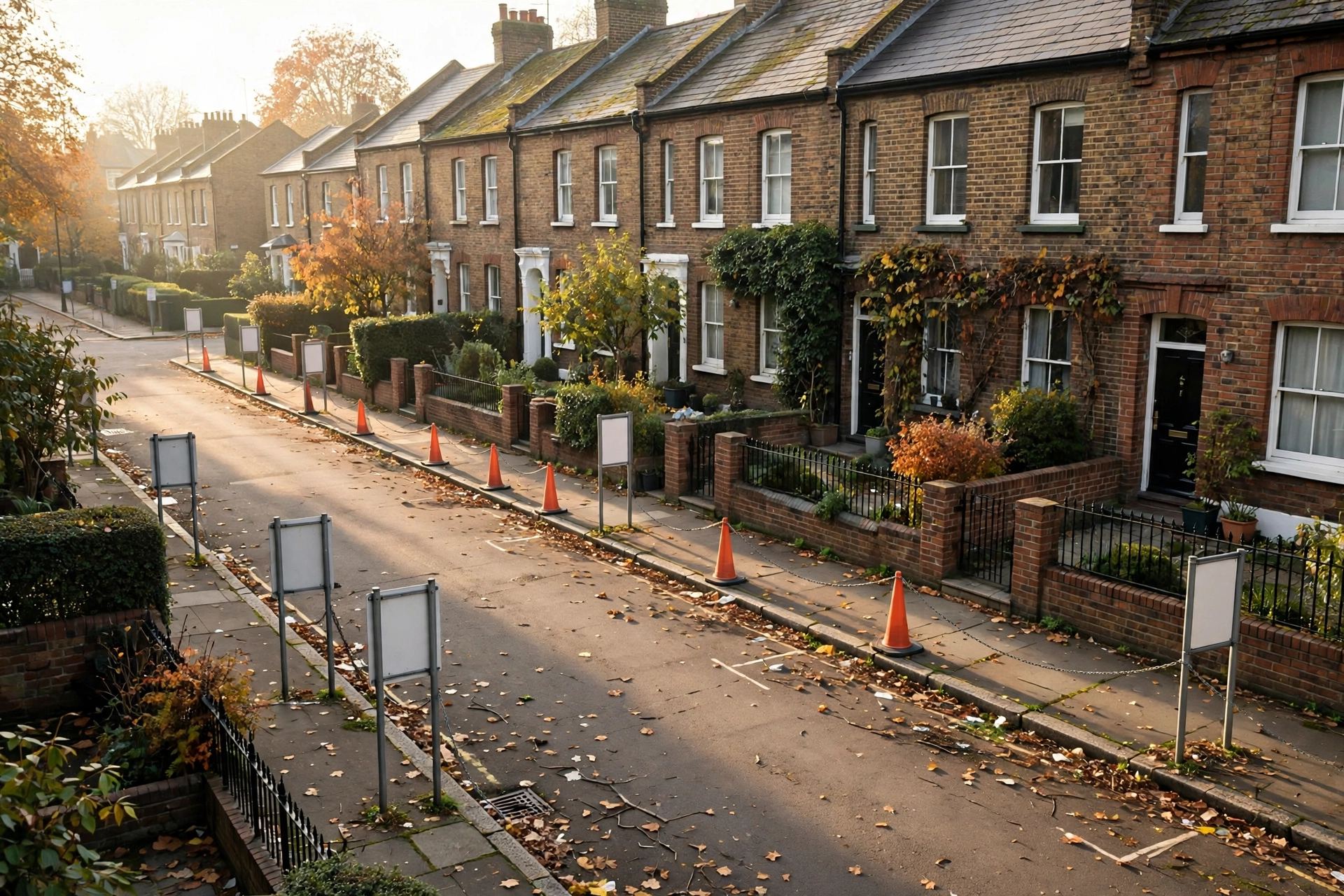
Controlled parking runs across much of the borough, and the hours are the trap. A street that looks unrestricted at 10am on a Saturday may be controlled on a weekday morning, and a street that is free after the evening may still need a suspension for a daytime move. Check the controls for the exact street, not for the area in general, and check both ends of the move if you are moving within the borough. A vehicle parked in a suspended bay without displaying a waiver notice, including one with a resident or visitor permit, may be issued with a penalty charge notice, so the notice in the windscreen is not a formality.
5. Wimbledon Village vs town centre vs Raynes Park
Wimbledon is the part of Merton most people picture first, and it is also the part where the access varies most from street to street. Wimbledon Village is period houses, narrow common-side streets and very limited kerbside space. A suspension is not optional there on most streets, it is the plan, and two bays is the right assumption for a Luton, not one. The carry is often from a front door straight onto the street, with no driveway to stage boxes in, so the crew works in a straight line from the house to the van, and anything that slows that line, a car in the bay or a van parked a street away, shows up in the hours.
Wimbledon town centre is a different move. Controlled parking covers the centre, and much of the housing is flats, so the day turns on lift and stair access rather than on the kerb. Book the lift through the building, confirm it in writing a few days before, and send the confirmation to the crew so the arrival time is built around the lift, not around a guess. A flat on a high floor with a booked lift is usually faster than a Village terrace with stairs; a flat on a high floor without one is not a move at all until the booking is made. Tell the building what is coming: a move with a sofa, a bed and a dining table needs the goods lift where there is one, not the passenger lift, and the loading bay needs to be clear for a van, not a car.
Raynes Park, Wimbledon Park, South Wimbledon and Merton Park sit between the two. Family streets, a mix of houses and flats, access that changes street by street rather than area by area. The same checks apply in each: the suspension, the lift booking where there is a lift, and a look at the street itself before the day, not on it. One more Wimbledon fact belongs here because it catches people out once a year. Temporary controls can apply around the Championships, so if your move falls in that fortnight, check with the council before you book anything. Do not rely on last year's arrangements, and do not guess the dates.

For Wimbledon itself, including the Village and the town centre, the starting point is the Wimbledon hub: Removals in Wimbledon.
6. Mitcham, Morden and Colliers Wood
The rest of the borough gets less attention from the Wimbledon-focused guides, and that is exactly why it deserves its own section. Mitcham, Morden, Colliers Wood and St Helier are where much of Merton actually lives, and the moves there are no less particular for being less written about. The streets are wider than the Village, the houses are a mix of interwar semis, post-war estates and newer flats, and the access question is usually the carry rather than the kerb: a longer walk from the van to the front door, a garden gate that will not take a wardrobe, a staircase that turns twice.
A suspension is still worth having in these areas, and the same ten working days apply. The wider streets tempt people to skip it, on the grounds that the van can always stop somewhere, but somewhere is not a plan. A van stopped half a street away from the front door adds minutes to every single carry, and a two-bedroom move has dozens of carries. The £110.25 for two bays for a day is cheaper than the extra hour of crew time it prevents, and it is the same charge as in Wimbledon, because the council's tariff does not change by area.
Morden and Colliers Wood also sit on the main routes out of the borough, which matters for timing in section 7. A move from Morden to Wimbledon, or from Mitcham to anywhere else in Merton, is a short drive and a long day if the loading is slow. Plan the loading first and the drive second. The borough's depth is in these streets, and a guide that only covers Wimbledon is a guide to half of Merton.
7. Planning the day, street by street
Merton's main routes are the A3, the A219 and the South Circular, the A205, and all three are slow at peak times. That matters twice: once for the drive between the two addresses, and once for the van getting to the first address at all. A crew booked to arrive at 8am that spends forty minutes in traffic on the A3 has lost forty minutes of loading time, and the day runs long from the start. Book the arrival for the quiet side of the peak where you can, and tell the crew the route you would take yourself, including the rat runs that only locals know.
The order of work for a Merton move runs backwards from the day itself. First the suspension, ten full working days ahead, because nothing else can be fixed until the bay is booked. Then the lift booking where there is a lift, confirmed in writing. Then the packing, which is section 9. Then the small things that are easy to forget: the waiver notice printed and in the windscreen, the keys and the completion timing if the move depends on an exchange, and a contact number that will be answered on the day. A move that crosses the river into the borough next door instead is planned the same way, with that borough's own parking figures, and our Greenwich guide works through the same approach there: Moving House in Greenwich: Costs, Parking and Planning.
Moving within the borough is usually the simplest version of the day: a short drive, sometimes no more than twenty minutes from Mitcham to Wimbledon or Morden to Raynes Park, and the whole day is decided by the loading and the unloading, not by the road. Moving out of the borough, to Surrey or into central London, adds the drive back into the calculation, and the worked totals in section 1 should be read with that in mind. The quote fixes the price before the day either way, so the drive is a planning question, not a billing surprise.
8. What the crew needs from you before the day
The crew can only move as fast as the access allows, so the most useful thing you can do before the day is remove every question the crew would otherwise have to ask on it. Tell them the parking: whether a suspension is booked, how many bays, and where the signs are. Tell them the access: which door the van should face, whether there is a lift and whether it is booked, how many floors the carry covers by stairs, and whether any piece of furniture needs to come apart. Tell them the timing: when the keys are available, whether the move depends on a completion, and what happens if the keys are late.
Have the waiver notice printed and in the windscreen before the van arrives, not after. Have the lift booking confirmation to hand, in writing, with the time window on it. Have a clear path from the front door to the van, and a room at the far end where boxes can be stacked without blocking the next load. None of this is complicated, and all of it is the difference between a crew that starts moving at 8am and a crew that spends the first hour working out where to stand.
One more thing the crew needs is honesty about the load. A move quoted for a two-bedroom flat that turns out to include a garden shed, a garage full of boxes and a piano that was never mentioned is a different move, and the day will run long no matter how good the crew is. The written quote is built on what you tell us. Tell us everything, and the quote holds.
9. Packing for a Merton move
Packing is the part of the move you control most, and the part that most often decides whether the day runs to time. If you book packing, it is charged at the same crew rate, with materials at cost: boxes £5 each, wrap £15, and tape £10 a roll. If you pack yourself, the same materials at the same prices are the honest way to cost it, and the same rule applies: label every box by room, not by contents, because the crew needs to know where a box goes, not what is inside it.

What travels in the van and what you carry yourself is worth deciding the night before, not on the morning. The van takes the furniture, the boxes and everything that is packed and labelled. You carry the valuables, the documents, the keys, the phone chargers and the first-night box: bedding, a kettle, tea and coffee, a change of clothes, and whatever the children or the pets need for the first evening. A wrapped picture frame travels in the van, protected and labelled; a passport travels in your bag. That split is the same on every move, and it is the one that keeps the first night comfortable instead of chaotic.
Start packing the rooms you use least, a week or more before the day, and leave the kitchen and the bedroom until last. A box packed early and labelled properly is a box the crew can stack without thinking. A box packed at midnight the night before, unlabelled and half full, is a box that slows every carry after it. If you are short on time, book the packing and let the crew do it at the same rate, rather than packing badly yourself and paying for the delay in crew hours.
10. How long a Merton move takes
Time is the real price of a move, because the card is hourly, so it is worth knowing what the hours are made of. A studio flat is usually about two hours of crew time on site, plus the travel between addresses. A one-bedroom flat is usually about three hours. A two-bedroom home is usually four to six hours, which is where the £340 to £510 range in section 1 comes from. A three-bedroom house is usually five to seven hours, which is where the £500 to £700 range comes from. Those are the on-site hours: loading, carrying and unloading. The drive between the two addresses sits on top, and the suspension and the lift booking decide whether the on-site hours stay inside those ranges or run past them.
Stairs are the biggest single influence on time. A ground-floor flat with a van at the door is the fastest move there is. A third-floor flat with no lift and a narrow staircase is the slowest, because every piece of furniture is carried, not rolled, and the crew rests between carries. The £5 per floor stair charge is the price of that; the time is the rest of it. Flats with a booked lift sit in the middle, and are often faster than a house with stairs, which is why the lift booking in section 5 matters as much as it does.
Long carries are the second influence. A van parked two streets away doubles the walking time of every carry, and a two-bedroom move has dozens of carries. That is the arithmetic behind the suspension: £110.25 for two bays for a day against the extra hour of crew time, £85 for 2 Men or £100 for 3 Men, that a distant van costs. A single item, a sofa or a wardrobe on its own, starts from £140, and is usually a one-hour job with Driver Help or a small crew, provided the access is straightforward.
11. The written quote and the terms
Everything in this guide comes together in the written quote, and the quote is where the price stops being a range and becomes a figure. It is built on the published hourly card, it lists what is included and what is not, and it is valid for seven days from the day it is given. If the move changes, the quote changes with it, in writing, before the day, not on it.
The terms are the same on every Merton move. There is no deposit to pay when you book. Cancellation is free up to 24 hours before the move, and cancelling inside 24 hours may be charged at up to 25% of the quoted price. Payment is at the time of service, and nothing is collected before unloading. Overruns are charged at the booked hourly rate, so a day that runs an hour long costs one more hour at the same rate. Packing is not included unless it is booked, and the council's parking charges are paid by you to the council directly, never marked up and never hidden inside the removals quote.
Read the quote before you accept it, and ask about anything that is not clear. A quote that lists the crew size, the hours, the stair charge where it applies, the packing where it is booked and the parking where it is separate is a quote you can plan around. A quote that does not list those things is a quote that will surprise you, and the surprise will arrive on the day when it is too late to fix.
12. Common Merton moving mistakes
The mistakes are the same on almost every Merton move that runs long, and all of them are avoidable. The first is applying for the suspension late. Ten full working days is not a suggestion and not a target to aim for; it is the minimum, and applying on the ninth working day is applying late. Apply the moment the date is fixed, not the week of the move.
The second is booking one bay when two are needed. A Luton needs about two bays, because one bay is five to six metres long, and a van that fits in one bay with its doors shut cannot be loaded from one bay. Book two, pay the £110.25, and load from the kerb instead of from halfway down the street.
The third is assuming the bay stays clear. A suspension is a permission, not a guarantee, and another driver may still park in it. Check the signs the day before, have the waiver notice in the windscreen, and know who to call if the bay is blocked on the morning. The fourth is forgetting the lift booking, or booking it for the wrong window, which strands the crew in a lobby with a sofa and nowhere to go. The fifth is packing the essentials: the kettle, the bedding and the phone charger in a box at the bottom of the van, instead of in the first-night box you carry yourself. And the sixth is the one that costs the most time of all, which is not telling the crew about the load. A garage, a shed or a piano that was never mentioned is a second move hiding inside the first.
13. Getting your quote
A Merton move is a straightforward job once the parking is booked and the access is known. The suspension is £110.25 for two bays for a day, the crew is £70, £85 or £100 an hour depending on the team, and the quote puts the two together in writing, valid for seven days, with no deposit and free cancellation up to 24 hours before.
Get your quote here: Get a Quote, or call Vano Removals on 07459 180023. Have the two addresses, the size of the property, the access at both ends and the date to hand, and say whether the street needs a suspension, because that is the one answer that decides how the day is planned. The quote comes back built around those details, and the move is planned before the van arrives.

Related services and guides


About the author

Ahmer Faiz, Founder, Vano Removals
Ahmer runs the small London crew that carries out every Vano move, sets the published hourly rates on this website, and replies to every Google review personally. Every guide on this site is written from the moves the team actually does, and checked against the council and TfL pages it quotes.
Reviewed by Ahmer Faiz on 5 November 2026 · Next review: 5 May 2027 · More about Vano Removals