Updated 14 November 2026 · Reviewed by Ahmer Faiz, Founder, Vano Removals
Greenwich rewards planning and punishes guessing. It is a borough of two very different kinds of move: the riverside towers of the Peninsula and Royal Arsenal, where the whole day turns on a booked goods lift and a loading bay slot, and the terraces of Greenwich Town Centre, East Greenwich and Charlton, where the whole day turns on a parking bay outside the front door. The price of the move itself is the same published hourly card wherever you are in the borough. What changes is the parking, the access and the timing, and this guide works through all three with real figures, so you can book with the cost already known.
1. What a Greenwich move costs
The hourly card is fixed and published, and it is the same card on every page of this site. Driver Help is £70 per hour, 2 Men with a van is £85 per hour, and 3 Men with a van is £100 per hour. Winter offer — £5 off every hourly rate. There is a two-hour minimum on every booking, and where the carry is by stairs there is a £5 charge per floor. Lift-served floors carry no floor charge. The totals below are crew time only, before any stair charge, so add £5 per floor if your stairs are part of the carry.
A studio flat with Driver Help for two hours comes to £140. A one-bedroom flat with 2 Men for three hours comes to £255. A two-bedroom terrace with 2 Men for four hours comes to £340, and the usual range for a two-bedroom home is £340 to £510, which is 2 Men for four to six hours. A three-bedroom house usually falls between £500 and £700, which is 3 Men for five to seven hours. These are the ranges to plan around, and the written quote you receive before the day is the figure that counts, valid for seven days from the day it is given.
Two costs sit outside the removals quote and catch people out if they are not separated early. The first is the council's parking suspension, covered in section 3, which you pay to the council directly. The second is packing, covered in section 9, which is charged only if you book it. Neither is hidden in the hourly rate, and neither should be. If you are comparing Greenwich with the borough next door, the Wandsworth guide from yesterday works the same way, with that borough's own parking figures: Moving House in Wandsworth: Costs, Parking and Planning.
For the borough as a whole, including the streets and the towers, the starting point is the Greenwich hub: Removals in Greenwich. For the service itself, the house removals page sets out what a full house move covers: House Removals.
2. What the hourly rate includes
The hourly rate covers the crew, the van and the work of the move itself. Loading, unloading and carrying are included, and so is dismantling and reassembly of furniture when it has been booked, which matters in Greenwich more than in most boroughs. The terraces around the town centre and the mansion blocks towards Blackheath were not built for king-size beds and three-seater sofas, and a bed that comes apart in ten minutes at the start of the day saves an hour of wrestling at the top of a staircase.
What the rate does not include is packing, unless you book it. Packing is charged at the same crew rate, with materials at cost: boxes £5 each, wrap £15, and tape £10 a roll. That separation is deliberate. Some customers want the crew to pack everything, and some want to pack themselves and keep the crew for the heavy work only. Either way the figure is agreed in writing before the day, not discovered on it.
Overruns are charged at the booked hourly rate, so a move that runs an hour long costs one more hour at the same rate, not a new rate. Payment is at the time of service. There is no deposit to pay when you book, cancellation is free up to 24 hours before the move, and cancelling inside 24 hours may be charged at up to 25% of the quoted price. Insurance is as stated in your written quote: ask us to confirm in writing.
3. The council's parking charges, and the second bay free
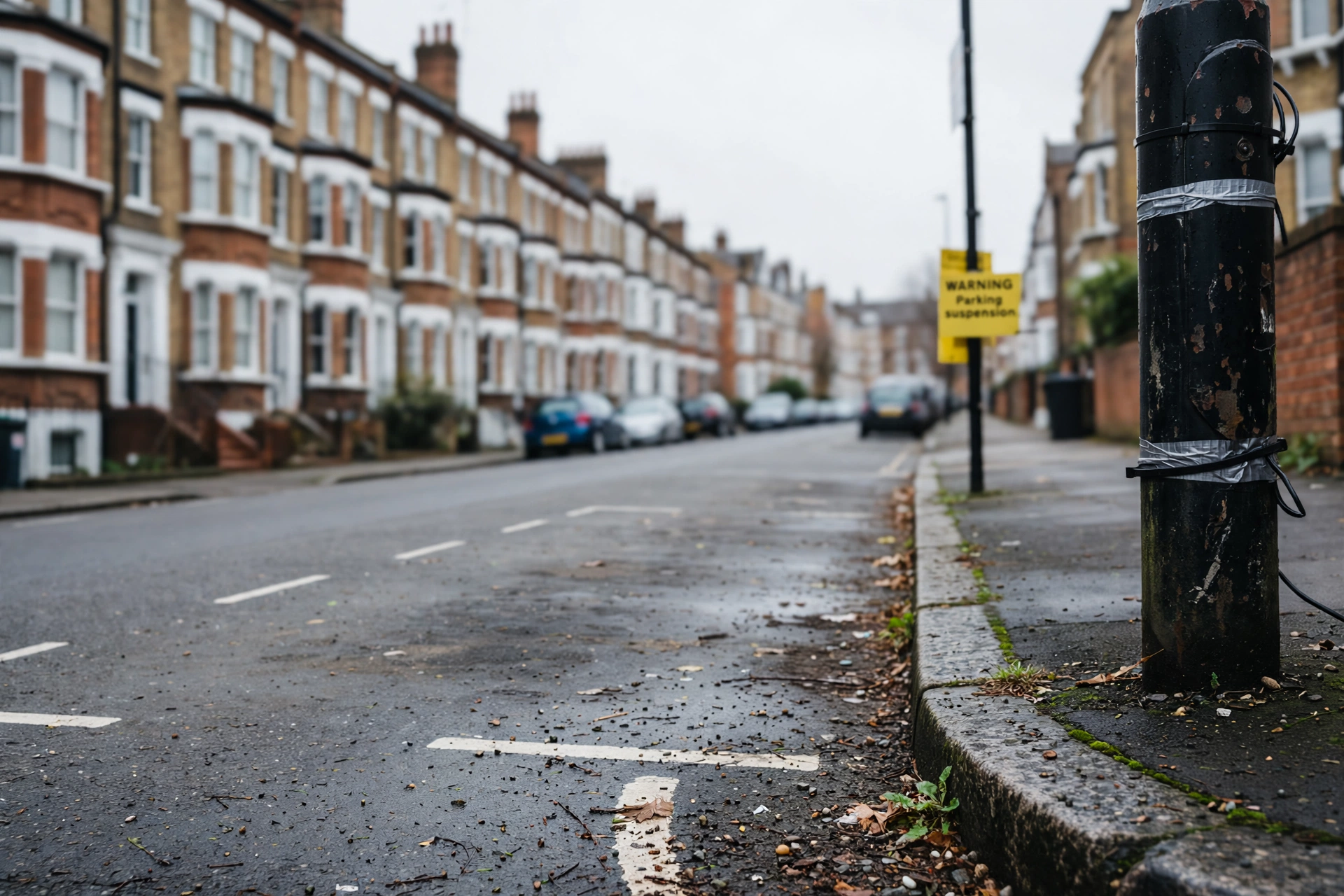
This is the section that saves Greenwich customers real money, and it is the one most guides get wrong by leaving it out. The Royal Borough of Greenwich charges £66.40 per bay per day for a parking suspension, plus an administration fee of £66.40 per application, which is non-refundable. So one bay for one day costs £132.80 in total, bay plus admin, paid to the council directly and never part of the removals quote.
Now the concession, which is the single most valuable Greenwich-specific fact in this guide. A resident who is moving house can ask to suspend a second bay at no charge on the first day of the suspension. Both bays are charged from the second day. Worked through, that means two bays for one day with the concession cost £132.80, the same as one bay, because the second bay is free on day one and the admin fee is charged once per application. Without the concession, two bays for one day would cost £199.20. Each further day for two bays costs £132.80, which is two bays at £66.40 each, with no further admin fee.
The notice period is 10 working days, and the council publishes no shorter route, so this is not a detail to leave until the week of the move. Ten working days means two full working weeks in practice, and a bank holiday in the middle stretches it further. Apply online to the council, and the council emails its decision. Approved bays are signed with the date and the reason, which is what tells other drivers the bay is reserved and why.
Two warnings belong here, because they are the two ways a suspended bay fails on the day. First, a vehicle parked in a suspended bay may get a penalty charge notice, but the council cannot stop people parking there and cannot remove vehicles. If someone is in your bay on the morning of the move, report it to Customer Services on 020 8921 4339 and keep the crew working around it where they can. Second, borough suspensions cover council streets only. The A2 and the A206 are TfL red routes under separate rules, so a suspension on a council street does not cover a red route frontage.
4. Yellow lines, CPZs and the streets that catch people out
Not every Greenwich street needs a bay suspension, and some need a different permission altogether. Where the van has to stand on a yellow line, the council offers a virtual parking dispensation at £34.30 per day. Apply online at least 7 working days before the move, and you will need an online permit account first, so set that up before you start the application rather than on the day you need it.
Controlled parking zones run on varied hours across the borough, and the hours are the trap. Greenwich Town Centre, zone G, runs Monday to Sunday, 9am to 5pm Monday to Saturday and 9am to 6pm on Sunday. East Greenwich, zone EG, runs Monday to Sunday, 9am to 6.30pm. Many other residential zones run shorter weekday windows, so a street that looks unrestricted at 10am on a Saturday may be controlled on a weekday morning, and a street that is free after 6.30pm may still need a suspension for a daytime move. Check the zone for the exact street, not for the area in general, and check both ends of the move if you are moving within the borough.
The streets that catch people out are the narrow ones: the terraces near Cutty Sark and the riverside, where a van that fits the road does not fit the road with cars parked on both sides, and the streets around the town centre where a bay that looks empty at 8am fills by 9am. If the van cannot get close, the carry gets longer, the hours get longer, and the bill follows. A suspension is cheaper than an extra hour of crew time, and in a tight street it is often the difference between a four-hour move and a six-hour one.
5. Towers, lifts and loading bays
The Peninsula and Royal Arsenal towers are a different move from a Greenwich terrace, and they need to be planned as one. The crew cannot simply arrive and start. Goods-lift bookings and loading-bay slots are arranged through the building, usually through the concierge, and they are booked for a window, not for the whole day. Miss the window and the move waits. Book it early, confirm it in writing a few days before, and send the confirmation to the crew so the arrival time is built around the lift, not around a guess.
Tell the building management what is coming. A tower move with a sofa, a bed and a dining table needs the goods lift, not the passenger lift, and the loading bay needs to be clear for a van, not a car. If the building has rules about protective coverings in lifts and corridors, find them out before the day, because the crew will follow them and the time they take is part of the move. A flat on a high floor with a booked lift is usually faster than a terrace with stairs; a flat on a high floor without one is not a move at all until the booking is made.
For houses, the equivalent of the lift booking is the parking suspension in section 3 and the stair check in section 8. The principle is the same in both cases: the access is booked before the van arrives, and the crew's time is spent moving, not waiting for access to be arranged.
6. Cancelling or changing a suspension
Plans change, and the council's cancellation terms are worth knowing before you apply, not after. Cancelling a suspension costs 20% of the cost or £66.40, whichever is more, and cancellation is possible up to the day before the suspension starts. On a small application the flat figure is the one that applies: one bay for one day costs £132.80, and 20% of that is £26.56, so the cancellation charge is £66.40. On a larger application the percentage takes over: two bays for three days cost £464.80 in total, which is the £66.40 admin fee plus three days at £132.80, and 20% of that is £92.96, so the cancellation charge is £92.96.
If the move date changes but the suspension is still needed, contact the council rather than assuming the signed bay moves with you. The bay is signed with a date and a reason, and a new date needs a new arrangement. The same 10-working-day notice applies, so a date change made a week before the move may not leave enough time for a fresh suspension, and the yellow-line dispensation in section 4, at 7 working days, may be the fallback if the street allows it.
Keep the council's decision email. It is the record of what was approved, and if a bay is signed for the wrong day or a neighbour queries the signs, the email settles it faster than any argument on the street.
7. Planning the day, street by street
A Greenwich move plans street by street, because the borough changes character every few minutes. Around Cutty Sark and the riverside, the streets are narrow, the parking is tight, and the suspension in section 3 is doing the heavy work. In the town centre, the controlled zone hours in section 4 decide when the van can stand and for how long. In East Greenwich, the residential streets are wider but the zone still runs to 6.30pm, so a late finish needs the same attention as an early start. Towards Charlton, the side streets are quieter and the access is usually easier, which is where a smaller crew can be the right call, and the same borough-by-borough method as the Wandsworth guide applies: work the parking first, then the crew size, then the day.
Start with the parking, ten working days out. Then confirm the lift or the stairs, the crew size and the arrival time. Then pack in the order the van will be loaded, heaviest and largest first, with the boxes for the first night at the new home loaded last so they come off first. A move that is planned in that order rarely runs over. A move planned the other way round, van first and parking last, is the one that pays for an extra hour standing in the street.
Allow for the river crossings. A move from Greenwich to north of the river, or from north of the river into Greenwich, crosses the Thames, and the crossing that looks quick on a map is not always quick at 9am. Tell the crew the route you expect and the time you expect it to take, and let them plan the loading so the van leaves once, loaded, rather than twice, half loaded.
8. What the crew needs from you before the day
The crew needs four things before the day, and none of them is complicated. First, the lift booking confirmation for a tower, or the suspension confirmation for a street, with the date and the bay or the lift window written on it. Second, the access at both ends: gate codes, concierge numbers, and whether the front door opens onto the street or into a shared hall with a second door. Third, a note of anything that does not fit through a door or up a staircase as it stands, so dismantling can be booked rather than improvised. Fourth, a clear statement of what travels in the van and what you are carrying yourself, because a box the crew does not know about is a box that gets loaded last, on top of everything else.
Measure the awkward pieces. A wardrobe that fits through a bedroom door does not always fit around the turn of a shared staircase, and a sofa that fits through a front door does not always fit through a flat door at the top of the stairs. The measuring guide from earlier in this run works through the method, door by door, and it is worth an evening with a tape measure before the day rather than an hour with a sofa on a landing during it.
If there is a parking restriction at the new home as well as the old one, arrange both suspensions. A move has two ends, and the second one is the one people forget, because all the planning goes into leaving. The van needs the same access at the new address, and the same 10-working-day notice applies there too.
9. Packing for a Greenwich move

Packing is the part of the move you control most, and it is where an hour spent the week before saves an hour on the day. Pack by room, label every box on two sides with the room it belongs to and a short note of what is inside, and keep the boxes for the first night separate: bedding, a change of clothes, phone chargers, kettle and mugs, basic cleaning things, and anything a child or a pet needs before the rest is unpacked. Load those last so they come off first.
Materials are at cost when packing is booked: boxes £5 each, wrap £15, tape £10 a roll. A two-bedroom home usually needs more boxes than its owners expect, and the honest way to plan is to count rooms, not guess. A kitchen alone fills more boxes than a bedroom, because it is full of small, heavy, breakable things, and a bookcase fills boxes that are heavy before they look full. Pack books in small boxes, pack plates on edge with wrap between them, and never pack a box you cannot lift. A box that is too heavy for one person is a box that slows the whole crew down.
The crew packs at the same crew rate when packing is booked, and the rate is agreed in writing before the day. What travels in the van and what you carry yourself should be agreed at the same time. Documents, jewellery, medication and anything irreplaceable travel with you, not in the van, and the crew will expect that. Everything else can go in the van, wrapped and labelled, in the order it will come off.
10. How long a Greenwich move takes
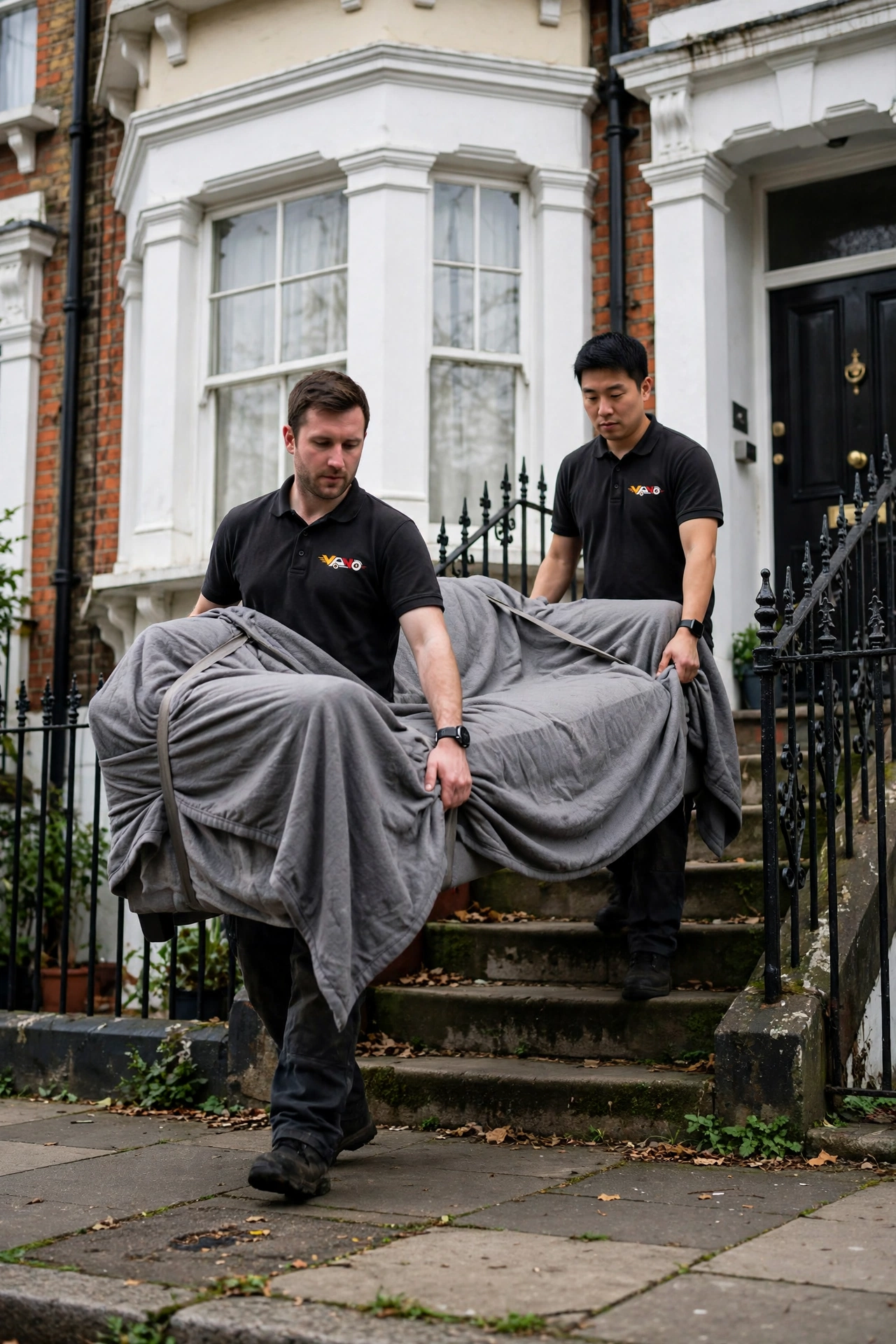
Time depends on three things: how much there is, how far the carry is, and how good the access is. A studio flat with Driver Help usually takes the two-hour minimum, provided everything is packed and the van can park at the door. A one-bedroom flat with 2 Men usually takes three hours. A two-bedroom terrace with 2 Men usually takes four to six hours, and a three-bedroom house with 3 Men usually takes five to seven hours. Those are the ranges behind the totals in section 1, and they hold when the access is as planned.
Stairs add time, and narrow stairs add more. A house with two flights of stairs and a turn on each landing takes longer than a house with one straight flight, and a flat on a third floor of a building without a lift takes longer still. The £5 per floor stair charge is the price of that time, and it is charged per floor where the carry is by stairs, not per flight of fancy. Lift-served floors carry no charge, which is one more reason to confirm the goods lift booking in section 5 before the day.
Distance between the two addresses adds time in a different way. A move within Greenwich, from one side of the borough to the other, is usually a single load and a short drive. A move out of Greenwich, across the river or out of London, adds the drive and the unloading at the far end, and the crew size should be chosen for the loading and unloading at both ends, not just the first. If the day is tight, the honest answer is a larger crew for fewer hours, not a smaller crew for more.
11. The written quote and the terms
Every move starts with a written quote, and the quote is the document that matters. It names the crew, the rate, the minimum, the date and the two addresses, and it is valid for seven days. If anything in it looks wrong, say so before the day, because the quote is the record both sides work from, and a correction made a week before costs nothing while a correction made on the morning costs time.
The terms are short and they are the same for every booking. No deposit is taken when you book. Cancellation is free up to 24 hours before the move. Cancelling inside 24 hours may be charged at up to 25% of the quoted price. Payment is at the time of service, and overruns are charged at the booked hourly rate. Packing is not included unless it is booked, and when it is booked it is charged at the same crew rate with materials at cost. Insurance is as stated in your written quote: ask us to confirm in writing.
Ask for the quote in writing even if the first conversation happens on the phone. A figure given in conversation is a starting point; a figure given in writing is a commitment, and it is the figure the crew works to on the day. Keep the quote with the council's suspension decision and the lift booking confirmation, and the day has its paperwork in one place.
12. Common Greenwich moving mistakes
The mistakes in Greenwich are specific, and they repeat often enough to list. The first is applying for the suspension late. Ten working days is not a suggestion, and a move booked a week out leaves no time for a suspension at all. The second is applying for one bay when two are needed. A van needs the bay it stands in and room to load, and the second bay is free on the first day for a house move, so there is no saving in going without it. The third is assuming the bay stays clear. It does not, and the council cannot remove a vehicle from it, so the plan for the morning should include what happens if the bay is occupied, not just what happens if it is empty.
The fourth mistake is forgetting the new address. A suspension at the old home and nothing at the new one leaves the van circling at the far end, and the hours run just the same. The fifth is booking the crew before booking the lift. A tower move without a goods-lift booking is a crew standing in a lobby, and the lobby is the most expensive place in the building to stand. The sixth is packing the wrong boxes first. The boxes for the first night should be packed last and loaded last, and the boxes nobody needs until next week should be packed first and loaded first.
None of these mistakes is expensive to avoid, and all of them are expensive to fix on the day. A suspension costs £132.80 for one bay for one day, and a second bay on the first day costs nothing extra. An extra hour of crew time costs £85 or £100. The arithmetic favours planning, every time.
13. Getting your quote
The next step is a written quote. Tell us where you are moving from and where you are moving to, the size of the home, and the date you have in mind, and the quote comes back in writing with the crew, the rate and the terms, valid for seven days. If the date depends on a completion or an exchange, say so, because the quote can be held to the date you need and the suspension can be timed to it.
For a Greenwich move, the two things to have ready when you ask are the parking and the access: whether the street needs a suspension, and whether the building needs a lift booking. With those two answers, the quote is straightforward, and the day is planned before the van arrives. Get your quote here: Get a Quote.
Related services and guides
About the author

Ahmer Faiz, Founder, Vano Removals
Ahmer runs the small London crew that carries out every Vano move, sets the published hourly rates on this website, and replies to every Google review personally. Every guide on this site is written from the moves the team actually does, and checked against the council and TfL pages it quotes.
Reviewed by Ahmer Faiz on 5 November 2026 · Next review: 5 May 2027 · More about Vano Removals