Updated 20 November 2026 · Reviewed by Ahmer Faiz, Founder, Vano Removals
Camden is the borough where the parking charge is the story, and most guides miss it entirely. Move house here and the council will waive the space charge for the first day, up to three consecutive spaces, and will not apply the short-notice charge either. That single rule turns a two-space, one-day booking from £225.92 in council charges into £66.66. The move itself costs the same published hourly card as anywhere else in London. What changes in Camden is the kerb, the access and the timing, and this guide works through all three with real figures, so you can book with the cost already known.
1. What a Camden move costs
The hourly card is fixed and published, and it is the same card on every page of this site. Driver Help is £70 per hour, 2 Men with a van is £85 per hour, and 3 Men with a van is £100 per hour. Winter offer, £5 off every hourly rate. There is a two-hour minimum on every booking, and where the carry is by stairs there is a £5 charge per floor. Lift-served floors carry no floor charge. The totals below are crew time only, before any stair charge, so add £5 per floor if your stairs are part of the carry.
Worked openly as rate times hours, a Camden move looks like this. A studio flat with Driver Help for two hours comes to £140. A one-bedroom flat with 2 Men for three hours comes to £255. A two-bedroom home with 2 Men for four hours comes to £340, and the usual range for a two-bedroom home is £340 to £510, which is 2 Men for four to six hours. A three-bedroom house usually falls between £500 and £700, which is 3 Men for five to seven hours. A single item, a sofa or a wardrobe on its own, starts from £140. These are the ranges to plan around, and the written quote you receive before the day is the figure that counts, valid for seven days from the day it is given.
For the borough as a whole, including Camden Town, Kentish Town and Hampstead, the starting point is the Camden hub: Removals in Camden. For the service itself, the house removals page sets out what a full house move covers: House Removals.
2. What the hourly rate includes
The hourly rate covers the crew, the van and the work of the move itself. Loading, unloading and carrying are included, and so is dismantling and reassembly of furniture when it has been booked, which matters in Camden more than in most boroughs. The period houses of Kentish Town and Hampstead and the mansion flats around Swiss Cottage and Belsize Park were not built for king-size beds and three-seater sofas, and a bed that comes apart in ten minutes at the start of the day saves an hour of wrestling at the top of a staircase.
What the rate does not include is packing, unless you book it. Packing is charged at the same crew rate, with materials at cost: boxes £5 each, wrap £15, and tape £10 a roll. That separation is deliberate. Some customers want the crew to pack everything, and some want to pack themselves and keep the crew for the heavy work only. Either way the figure is agreed in writing before the day, not discovered on it.
Overruns are charged at the booked hourly rate, so a move that runs an hour long costs one more hour at the same rate, not a new rate. Payment is at the time of service, and nothing is collected before unloading. There is no deposit to pay when you book, cancellation is free up to 24 hours before the move, and cancelling inside 24 hours may be charged at up to 25% of the quoted price.
Insurance is as stated in your written quote: ask us to confirm in writing.
3. The council's parking charges, and the home-move exemption that saves £159.26 on day one
This is the section that saves Camden customers real money, and it is the one most guides get wrong by leaving it out. Camden Council charges an administration fee of £66.66 for each suspension created, plus a space charge per space per day that depends on the length of the booking. For one day the space charge is £79.63 per space. For two to five days it is £87.61 per space per day, for six to ten days £95.56, for eleven to fourteen days £103.55, for fifteen to forty-two days £119.49, and for forty-three to one hundred and eighty-three days £151.34. A space is five metres long, so a Luton van needs about two spaces. You can only suspend parking spaces on a street for up to six months, and a longer booking needs a temporary traffic order instead.
Without any exemption, two spaces for one day would cost £225.92, which is the £66.66 admin fee plus two spaces at £79.63 each. That is the figure a builder or a film crew would pay. A home move does not pay it, because the council's own rule for people moving home says, in its own words: "If you're moving home you do not have to pay the suspension space charge for the first day only (up to 3 consecutive spaces) and the short notice charge does not apply. The administration charge will still apply."
So a two-space, one-day home move costs £66.66 in council charges, admin only, and saves £159.26 against the £225.92 that the same booking would cost without the exemption. The exemption covers the first day only and up to three consecutive spaces, so a move that needs a second day pays the space charge for that second day, and a move that needs four spaces pays the space charge on the fourth. Do not call the exemption a discount. It is the council's home-move rule, and it applies to the first day of a genuine home move, not to any other kind of booking.
The short-notice charge is £349.81, and it is the figure that catches people who book late. For a home move the short-notice charge does not apply, even when the booking is made late, because the exemption covers it. That does not make late booking free of risk. A suspension booked late may still be granted, but the council cannot guarantee the space, and the warning period that makes it more likely the bay is free is shorter. The exemption saves the charge. It does not save the bay.
One more council fact belongs here. There is an exemption when a vehicle is continuously engaged in a property move, but arranging a suspension makes it more likely spaces will be free, and a trade permit may also meet your needs. Relying on the moving-vehicle exemption without a suspension is a gamble on the street being empty when the van arrives. A suspension is the plan, and for a home move the first day of it costs £66.66.
4. Seventeen days' notice: booking the suspension in time
The council's guidance is to book at least seventeen days in advance of the start date of the suspension. Seventeen days is not a deadline in the way ten working days is in some boroughs. It is guidance, and the council says plainly that booking at least seventeen days ahead allows for a warning period, meaning it is more likely the space will be available. If you book later than seventeen days before the suspension starts, you may incur a short-notice charge, though for a home move that charge does not apply under the exemption in section 3.
The minimum period that you can book a suspension is three days before a suspension starts, so a move booked with less than three days to go cannot have a suspension at all. Between three days and seventeen days, a suspension can be booked, but the warning signs have less time to do their work, and the bay is less likely to be clear on the morning.
You can make changes up to four days before the suspension starts, for dates and times, the number of spaces, the suspension reason, and the location text description. You can change a customer reference and vehicle registration fields at any time. If you add spaces which are not next to your booked spaces, or within a different bay, that counts as a new suspension, with a new admin charge, so check the number of spaces and their position before you submit, not after.
To book, you need the street name or postcode of where the spaces are, the date and times you want to suspend the space for, a full and clear description of where the spaces are, for example "outside number 20 only", the vehicle registration numbers of all the vehicles using the spaces, and a debit or credit card. Your text description appears on the sign, so do not enter personal information, abbreviations or the postcode. A single space, a whole bay or a group of bays may be suspended, and a space cannot be suspended for preferential or convenience parking.
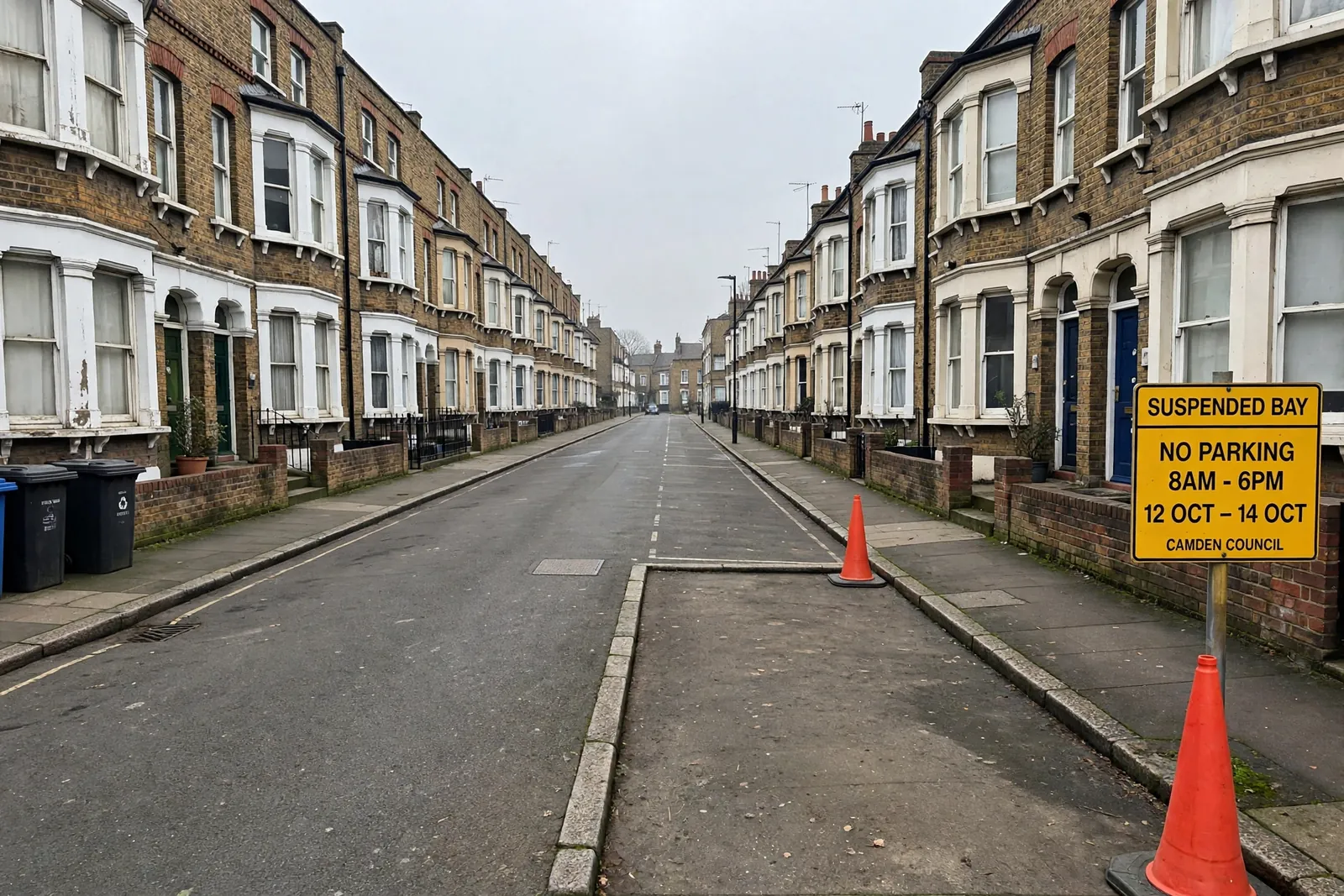
The streets that catch people out are the narrow ones, and Camden has plenty of them: the period streets of Kentish Town and Hampstead, the roads around Camden Town where the market crowds the pavements, and the mansion-block streets where a van that fits the road does not fit the road with cars parked on both sides. If the van cannot get close, the carry gets longer, the hours get longer, and the bill follows. A suspension is cheaper than an extra hour of crew time, and in a tight street it is often the difference between a four-hour move and a six-hour one.
Controlled parking runs across much of the borough, and the hours are the trap. A street that looks unrestricted at 10am on a Saturday may be controlled on a weekday morning, and a street that is free after the evening may still need a suspension for a daytime move. Check the controls for the exact street, not for the area in general, and check both ends of the move if you are moving within the borough. Parking suspensions are indicated on streets by yellow warning signs, and those signs carry the exact location and up-to-date information, so check them on the day as well as in advance.
5. Camden Town vs Kentish Town vs Hampstead
Camden is a borough of three very different kinds of move, and the mistake is treating them as one. Camden Town is market streets and flats, with Camden High Street at its centre and controlled parking on the streets around it. The day turns on the kerb and the timing: a suspension booked seventeen days ahead, two spaces for a Luton, and an arrival that avoids the worst of the market crowds. The flats above the shops and the conversions off the High Street often have narrow stairs and no lift, so the carry is by stairs and the £5 per floor charge in section 1 is part of the honest total, not a surprise.
Kentish Town is period houses and terraces, with Kentish Town Road running through it and residential streets on either side. The houses are the classic Camden move: a front door straight onto the street, no driveway to stage boxes in, and a staircase that turns. The crew works in a straight line from the house to the van, and anything that slows that line, a car in the bay or a van parked a street away, shows up in the hours. A suspension is not optional here on most streets, it is the plan, and two bays is the right assumption for a Luton, not one.
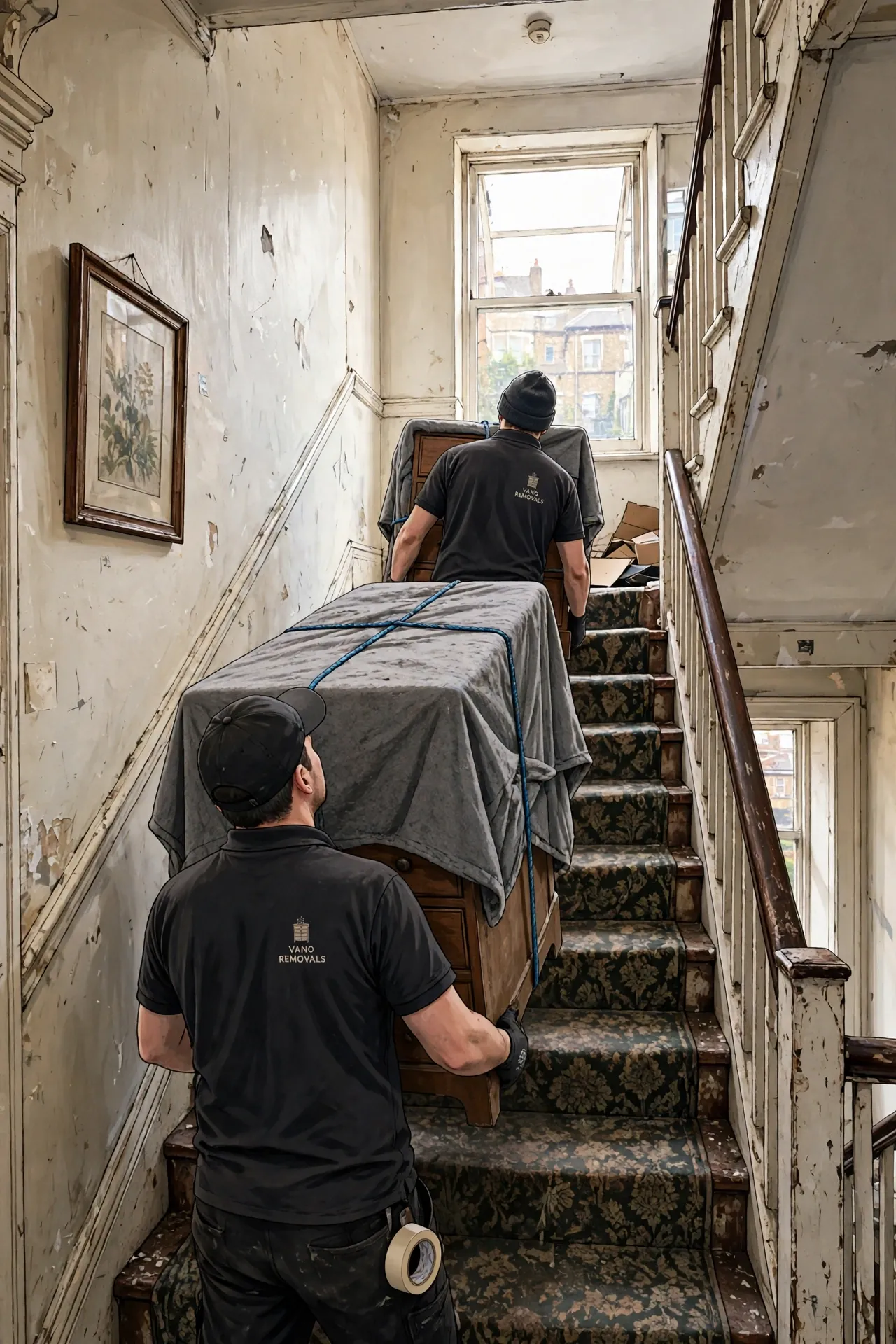
Hampstead is the third kind of move, and the most varied. Period houses, mansion flats and streets that climb, with lift bookings in the mansion blocks and long carries in the houses. A flat on a high floor with a booked lift is usually faster than a Kentish Town terrace with stairs. A flat on a high floor without one is not a move at all until the booking is made. Tell the building what is coming: a move with a sofa, a bed and a dining table needs the goods lift where there is one, not the passenger lift, and the loading bay needs to be clear for a van, not a car. Book the lift through the building, confirm it in writing a few days before, and send the confirmation to the crew so the arrival time is built around the lift, not around a guess.
For the borough as a whole, the Camden hub carries the same three areas in detail, and the same parking figures: Removals in Camden.
6. Primrose Hill, Belsize Park and Swiss Cottage
The rest of the borough gets less attention from the Camden Town-focused guides, and that is exactly why it deserves its own section. Primrose Hill, Belsize Park and Swiss Cottage are where much of Camden actually lives, and the moves there are no less particular for being less written about. Primrose Hill is period houses and quiet residential streets, with the same narrow-street and controlled-parking questions as Kentish Town. Belsize Park and Swiss Cottage are mansion flats and period conversions, where the access question is usually the lift booking and the loading bay rather than the kerb.
A suspension is still worth having in these areas, and the same seventeen-day guidance applies. The quieter streets tempt people to skip it, on the grounds that the van can always stop somewhere, but somewhere is not a plan. A van stopped half a street away from the front door adds minutes to every single carry, and a two-bedroom move has dozens of carries. The £66.66 for a two-space, one-day home move, admin only under the exemption, is cheaper than the extra hour of crew time it prevents, and it is the same charge as in Camden Town, because the council's tariff does not change by area.
West Hampstead and the Highgate edge of the borough sit on the same pattern: family streets, a mix of houses and flats, access that changes street by street rather than area by area. The same checks apply in each: the suspension, the lift booking where there is a lift, and a look at the street itself before the day, not on it. A guide that only covers Camden Town is a guide to a third of Camden.
7. Planning the day, street by street
Camden's main routes are the A400, the A41 and the A5, and all three are slow at peak times, with Camden High Street and Kentish Town Road slow in their own right when the market and the shops are busy. That matters twice: once for the drive between the two addresses, and once for the van getting to the first address at all. A crew booked to arrive at 8am that spends forty minutes in traffic on the A41 has lost forty minutes of loading time, and the day runs long from the start. Book the arrival for the quiet side of the peak where you can, and tell the crew the route you would take yourself, including the rat runs that only locals know.
The order of work for a Camden move runs backwards from the day itself. First the suspension, seventeen days ahead, because nothing else can be fixed until the bay is booked. Then the lift booking where there is a lift, confirmed in writing. Then the packing, which is section 9. Then the small things that are easy to forget: the suspension details printed and to hand, the keys and the completion timing if the move depends on an exchange, and a contact number that will be answered on the day. A move that crosses into the borough next door instead is planned the same way, with that borough's own parking figures, and our Merton guide works through the same approach there: Moving House in Merton: Costs, Parking and Planning.
Moving within the borough is usually the simplest version of the day: a short drive, sometimes no more than twenty minutes from Kentish Town to Hampstead or Camden Town to Primrose Hill, and the whole day is decided by the loading and the unloading, not by the road. Moving out of the borough, to north London or into central London, adds the drive back into the calculation, and the worked totals in section 1 should be read with that in mind. The quote fixes the price before the day either way, so the drive is a planning question, not a billing surprise.
8. What the crew needs from you before the day
The crew can only move as fast as the access allows, so the most useful thing you can do before the day is remove every question the crew would otherwise have to ask on it. Tell them the parking: whether a suspension is booked, how many bays, and where the signs are. Tell them the access: which door the van should face, whether there is a lift and whether it is booked, how many floors the carry covers by stairs, and whether any piece of furniture needs to come apart. Tell them the timing: when the keys are available, whether the move depends on a completion, and what happens if the keys are late.
Have the suspension details to hand before the van arrives, not after. Have the lift booking confirmation in writing, with the time window on it. Have a clear path from the front door to the van, and a room at the far end where boxes can be stacked without blocking the next load. None of this is complicated, and all of it is the difference between a crew that starts moving at 8am and a crew that spends the first hour working out where to stand.
One more thing the crew needs is honesty about the load. A move quoted for a two-bedroom flat that turns out to include a garden shed, a garage full of boxes and a piano that was never mentioned is a different move, and the day will run long no matter how good the crew is. The written quote is built on what you tell us. Tell us everything, and the quote holds.
9. Packing for a Camden move
Packing is the part of the move you control most, and the part that most often decides whether the day runs to time. If you book packing, it is charged at the same crew rate, with materials at cost: boxes £5 each, wrap £15, and tape £10 a roll. If you pack yourself, the same materials at the same prices are the honest way to cost it, and the same rule applies: label every box by room, not by contents, because the crew needs to know where a box goes, not what is inside it.

What travels in the van and what you carry yourself is worth deciding the night before, not on the morning. The van takes the furniture, the boxes and everything that is packed and labelled. You carry the valuables, the documents, the keys, the phone chargers and the first-night box: bedding, a kettle, tea and coffee, a change of clothes, and whatever the children or the pets need for the first evening. A wrapped picture frame travels in the van, protected and labelled; a passport travels in your bag. That split is the same on every move, and it is the one that keeps the first night comfortable instead of chaotic.
Start packing the rooms you use least, a week or more before the day, and leave the kitchen and the bedroom until last. A box packed early and labelled properly is a box the crew can stack without thinking. A box packed at midnight the night before, unlabelled and half full, is a box that slows every carry after it. If you are short on time, book the packing and let the crew do it at the same rate, rather than packing badly yourself and paying for the delay in crew hours.
10. How long a Camden move takes
Time in Camden is decided by access, not by distance. A studio flat with Driver Help usually takes two hours, which is the £140 worked total in section 1. A one-bedroom flat with 2 Men usually takes three hours, which is £255. A two-bedroom home with 2 Men usually takes four to six hours, which is the £340 to £510 range. A three-bedroom house with 3 Men usually takes five to seven hours, which is £500 to £700. Those are the ranges to plan around, and they assume the suspension is booked, the lift is booked where there is one, and the boxes are packed and labelled before the crew arrives.
Stairs add time in a way that is easy to underestimate. A carry by stairs is slower than a carry by lift, and a carry from a top-floor flat with no lift is slower still. That is why the £5 per floor charge exists, and why the lift booking in section 5 is not a formality. A mansion flat with a booked goods lift can be faster than a two-storey terrace with a turning staircase, even though the flat is higher up. The building matters more than the floor number.
The drive matters too, and in Camden it matters in both directions. A move within the borough is a short drive and a long loading day. A move out of the borough, across London or to the north, adds the drive to the total, and the crew time on the road is crew time on the clock. The written quote fixes the price before the day, so the drive is a planning question, and the honest way to read the worked totals is with the drive already in mind.
11. The written quote and the terms
The written quote is the figure that counts, and it is valid for seven days from the day it is given. It is built on the hourly card in section 1, the worked totals for your property size, the stair charge where the carry is by stairs, and the packing materials where packing is booked. It is not a guess, and it is not changed on the day unless the load itself has changed. If you tell us everything in section 8, the quote holds.
The terms are the same on every move, and they are worth reading before the day rather than on it. There is no deposit to pay when you book. Cancellation is free up to 24 hours before the move, and cancelling inside 24 hours may be charged at up to 25% of the quoted price. Payment is at the time of service, and nothing is collected before unloading. Overruns are charged at the booked hourly rate, so a move that runs an hour long costs one more hour at the same rate, not a new rate.
Insurance is as stated in your written quote: ask us to confirm in writing.
12. Common Camden moving mistakes
The first mistake is booking the suspension late, or not at all. Seventeen days is the guidance, and three days is the minimum, so a move booked with a week to go is already late for the warning period, even though the home-move exemption means the short-notice charge does not apply. Book the suspension when you book the move, not when you pack the last box.
The second mistake is paying the space charge on day one when the exemption applies. The council's rule is clear: for a home move, you do not have to pay the suspension space charge for the first day only, up to three consecutive spaces, and the short-notice charge does not apply. The administration charge still applies, so the first day costs £66.66, not nothing, and not £225.92. If a booking form or a third party quotes you the full £225.92 for a one-day home move, the exemption has been missed.
The third mistake is booking one space when two are needed. A space is five metres, and a Luton needs about two, so one space is a van with its nose in the next bay and its tail in the traffic. Book two spaces, and book them as consecutive spaces, because the exemption covers up to three consecutive spaces, and a space that is not next to the others counts as a new suspension.
The fourth mistake is forgetting the lift. A mansion flat with no lift booking, a goods lift booked for the wrong hour, or a passenger lift used for a sofa that does not fit it, all cost hours. Book the lift, confirm it in writing, and send the confirmation to the crew.
The fifth mistake is packing late. A box packed at midnight the night before, unlabelled and half full, slows every carry after it, and the crew time it costs is more than the packing time it saved. Pack early, label by room, and leave the kitchen and the bedroom until last.
13. Getting your quote
A Camden move starts with a written quote, and the quote starts with the details in section 8: the two addresses, the property sizes, the access at each end, the stairs and the lift, the suspension, and the load itself. Tell us everything, and the quote you receive is the figure that counts, valid for seven days, with no deposit to pay when you book and nothing collected before unloading.
Get your quote here: Get a Quote.
Related services and guides

About the author

Ahmer Faiz, Founder, Vano Removals
Ahmer runs the small London crew that carries out every Vano move, sets the published hourly rates on this website, and replies to every Google review personally. Every guide on this site is written from the moves the team actually does, and checked against the council and TfL pages it quotes.
Reviewed by Ahmer Faiz on 5 November 2026 · Next review: 5 May 2027 · More about Vano Removals