Updated 14 November 2026 · Reviewed by Ahmer Faiz, Founder, Vano Removals
A move across London is a logistics problem. A move from London to Manchester is a different animal: roughly 200 miles, around four hours on the road in normal traffic, and a day that has to be planned around the drive as much as around the packing. People do it every week — for work, for family, for a bigger house at a smaller price — and the moves that go well share the same pattern: the long-distance parts were thought about early, not discovered on the day.
Why long-distance changes the planning
In a local move, a forgotten item is a ten-minute drive back. On a London to Manchester run, there is no going back — once the van leaves, whatever is not in it travels by train with you, by courier, or not at all. That single fact shapes everything: the packing has to be finished before loading starts, the "keep with you" pile matters more, and the order of the day is fixed by the motorway, not by convenience.
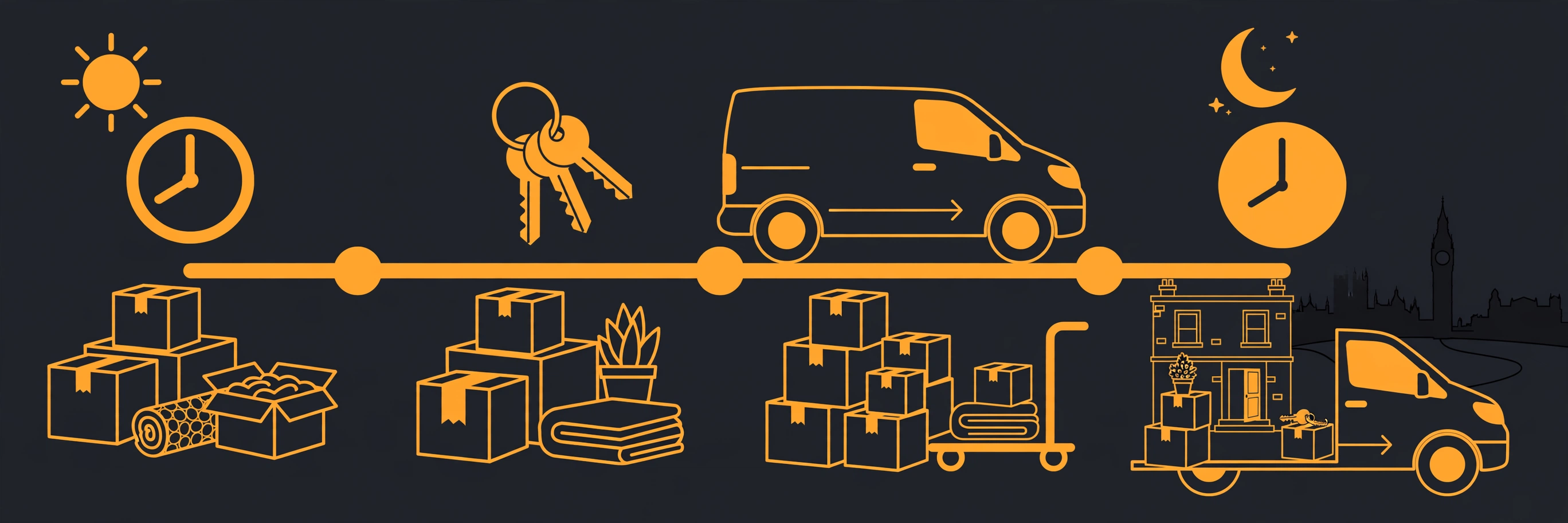
Timing works differently too. A crew loading in London in the morning is unloading in Manchester in the afternoon or early evening, depending on traffic on the M1 and M6. If the keys for the new place are not released until the afternoon, the day needs a plan for the gap — or a later start — agreed in advance, not improvised on the hard shoulder.
The written quote matters more, not less
Long-distance moves are quoted individually, in writing, because the price depends on things a local move does not have: the distance, the total volume, the access at both ends, and whether the day needs one crew travelling the whole way or a different arrangement. When you request quotes, give the full picture: both postcodes, the property types, floors and lifts at each end, parking at each end, and the complete list of what is travelling.
Get the answers to three questions in the quote itself. First: what exactly is included in the driving — is the journey and the crew's time part of the quoted figure? Second: what happens if completion delays the keys at the Manchester end and the crew is waiting — is waiting time charged, and how? Third: what is the plan if traffic breaks the schedule — does unloading happen the same evening regardless? None of these are trick questions; they are the three places long-distance moves actually go wrong, and a company that runs the route will answer them plainly.
What the journey costs, worked openly
London to Manchester is roughly 200 miles via the M1 and M6, about four hours of driving in clear traffic, and the crew's day is built around that: loading in London, the motorway run, unloading in Manchester and the journey home. On our published card the route is worked at £765 of crew time for a 2 Men team, set out with its workings on our London to Manchester route guide, and your written quote settles the figure for your actual load and addresses before you book. Two honest extras to know about: the M6 Toll is £20.20 for a van if the route uses it, and Manchester has no Clean Air Zone (the planned zone was ruled out in January 2025), so there is no daily emissions charge to argue about on this route.
Pack for one journey, not two
Because loading happens once, pack as if the van is a sealed system: everything labelled by room at the destination, not the origin. Fragile items need the same wrapping discipline as any move, but with four hours of motorway vibration in mind — boxes packed snug, nothing rattling, weight spread evenly. Our guide to what to pack in your first-night box when moving house in London matters twice over on a long-distance move: the kettle, bedding, chargers, documents and medication travel with you in the car or the cab, never buried in the van, because the van's first box off might be hours behind you if your journeys split. If you would rather not pack at all, our packing service can take the whole job on.
Perishables and houseplants follow the same rule as any move — they do not belong in a closed van for hours. Eat down the freezer the week before; plants travel with you or not at all.
What does not travel 200 miles
A long-distance load is sealed once and opened two hundred miles later, so a few things should not be in it. Food, beyond the sealed and shelf-stable, will not thank you for four hours in a van. Houseplants in a cold month face the same problem as the food, only slower. Anything you will need in the first hours in Manchester (documents, medication, chargers, the kettle box, a change of clothes) belongs in your car, because a van that is delayed is a van you cannot open at a service station. And the truly irreplaceable items, the documents and jewellery and keepsakes with no second copy, travel with you as a matter of policy on any long move, whoever carries the rest.
The two addresses are two different problems
Access rarely matches at both ends. The London end might be a third-floor flat with a lift booking and a parking suspension to arrange; the Manchester end might be a house with a driveway and no restrictions at all — or the reverse. Walk through both ends when you book: where the van parks, how far the carry is, what the building rules are, and who is meeting the crew at the destination if you are travelling separately.
Keys deserve their own plan. If you are collecting keys from an agent in Manchester, build the collection into the schedule with slack — a van and crew waiting outside a locked house is the most expensive way to spend an afternoon, and the most common long-distance frustration there is.
Keys and completion on a long-distance day
On a local move, a two-hour delay at completion is an inconvenience. On a London to Manchester move it can decide whether the unload happens in daylight or at all, so the day is planned backwards from the keys. In a chain, keys usually release around 1 to 2 in the afternoon; the crew leaves London early enough to be useful at both ends, and your written quote stage is where the what-if is settled: what happens if completion slips to the evening, and whether the unload moves to the next morning. Ask it before you book, while the answer is free, rather than at a motorway service station with a loaded van behind you.
Moving day itself: what a good one looks like
Loading finishes, the driver does a final walk-through with you — every room, every cupboard — because there is no return trip. You travel with the essentials. At the destination, rooms get checked off as boxes land in them, furniture is placed before smaller items arrive, and the beds are built before the crew leaves, because after a 200-mile day nobody is assembling a bed frame at midnight by choice. Confirm when you book that dismantling and reassembly is included for the items that need it.

And then the honest final point: a London to Manchester move is a long day, not an impossible one. It rewards people who finish packing the day before, keep the paperwork with them, and agree the what-ifs in writing while everyone is still calm.
Before you book
Ask for the quote in writing, give both postcodes and the full inventory, and agree the timing plan — loading time, the drive, keys, and what happens if the day slips. That is the whole secret. Our long-distance moves page explains how we run these jobs, and if Manchester is your destination, tell us both addresses when you request your quote and we will confirm the full plan in writing before anything is booked. Our London to Manchester removals service covers this route in full. For the full route detail, see our complete Manchester guide.
Planning a move from London to Manchester? Call Vano Removals on 07459 180023 or get a written quote.
Questions people ask about London to Manchester moves
Can it be done in one day? Yes, and most are: an early London load, the motorway run, an afternoon unload in Manchester. Very large loads, or a completion expected late in the day, are sometimes split across two days by agreement at the quote stage.
Is there a Clean Air Zone charge in Manchester? No. Manchester's planned charging zone was ruled out in January 2025, so there is no daily charge for the van. The route's one toll is the optional M6 Toll, £20.20 for a van.
How early should a long-distance move be booked? As soon as your dates are firm. Long-distance days take a whole crew and vehicle for a full day, so the calendar fills earlier than for local moves, especially at month ends.
Related services and guides
About the author

Ahmer Faiz, Founder, Vano Removals
Ahmer runs the small London crew that carries out every Vano move, sets the published hourly rates on this website, and replies to every Google review personally. Every guide on this site is written from the moves the team actually does, and checked against the council and TfL pages it quotes.
Reviewed by Ahmer Faiz on 5 November 2026 · Next review: 5 May 2027 · More about Vano Removals